Ebook Info
- Published: 2012
- Number of pages: 416 pages
- Format: PDF
- File Size: 11.25 MB
- Authors: Irving Adler
Description
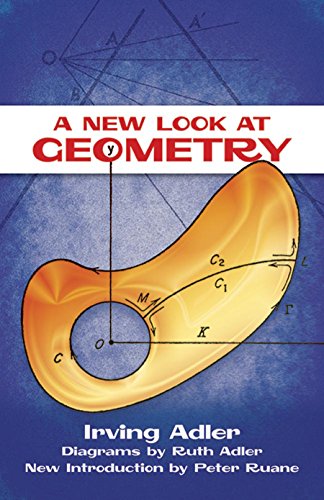
This richly detailed overview surveys the development and evolution of geometrical ideas and concepts from ancient times to the present. In addition to the relationship between physical and mathematical spaces, it examines the interactions of geometry, algebra, and calculus. The text proves many significant theorems and employs several important techniques. Chapters on non-Euclidean geometry and projective geometry form brief, self-contained treatments.More than 100 exercises with answers and 200 diagrams illuminate the text. Teachers, students (particularly those majoring in mathematics education), and mathematically minded readers will appreciate this outstanding exploration of the role of geometry in the development of Western scientific thought.Introduction to the Dover edition by Peter Ruane.
User’s Reviews
Editorial Reviews: About the Author The author of many books on math and science, Irving Adler taught in New York City high schools during the 1930s and 40s and pursued a long career as a political activist and lecturer.
Reviews from Amazon users which were colected at the time this book was published on the website:
⭐I bought this book out of curiosity for my book collection. It turned out to be a very interesting reading on the topic.It covers, in a kind of unified way, Euclidean and non-Euclidean Geometries, Analytic Geometry, the role of Geometry in Physics, Projective Geometry, some Differential Geometry and some Topology. The presentation blends the exposition of ideas with historical facts making it easy and entertaining to read and follow. To be honest, this came as a big surprise to me for the following reason: The author uses (the very short) Chapter 1 instead of a Preface to the book. He entitles it `One Book and Three Metaphors’. After reading it, I did understand his plan (and his metaphors) but I found Chapter 1 to be silly and superficially written. Other people may like it but, for some reason, I hated it! I thought that the author did not really know to write well and, if he could not make an exciting use of metaphors, imagine what failure would be his writing on the technical material. Yet, I could not be more wrong! As I kept reading, I liked the writing more and more. I liked the way he makes connections among the various topics and the way explanations are presented. Without any doubt the author understood Geometry deeply. Any reader (from high school students and above) will benefit greatly from this book which I certainly recommend strongly.However, this book is not a textbook. Therefore if you are looking on a book that is a standard text on any of the topics covered in it — synthetic Euclidean Geometry, non-Euclidean Geometries, Projective Geometry, Analytic Geometry and especially Geometry in Physics, History of Geometry, Differential Geometry, or Topology — this is not what you should buy and read. The first four topics are covered relatively extensively, the next two less extensively and the last two very little. The coverage, although robust and precise when necessary, is also more relaxed than the coverage of a dedicated textbook and often a discussion or proof mixes ideas from more than one topic.Overall, no matter who you are — knowledgeable in math or a beginner, you will benefit from reading this book. However, if you are a beginner keep in mind my second paragraph, until you learn to recognize the conventional borderlines of the various areas of geometry.
⭐I read this book in the 1960s and really enjoyed the way geometry was presented in it. I enjoyed re-reading it again after 50 years and saw again what my teenage self saw so wonderful about this gem of a book on geometry.
⭐The book arrived in good condtion
⭐I thank amazon’s reviewers of this work, whose opinions inflenced me to buy it. The author is able to clarify in few words “tricky” concepts. For example: “what is a cotinuous function?” or “what is a complete quadrangle in projective geometry?”). I like very much the bright and clear chapters 3 and 8, on Euclidean geometry, and non-Euclidean geometries (mainly hyperbolic geometry and some hints on elliptic geometry). Chapter 4 is fine; it develops the cartesian way of doing Euclidean geometry. Chapter 6 is a valuable development of Euclidean geometry following Bachman’s system of axioms, where points, lines and mirror reflections are the basic notions. Chapter 10 is a quick but well thought introduction to synthetic projective geometry; it is very good indeed. Given three points A, B and C on a line r in a projective space, Adler explains (with excellent notation and diagrams) how to construct a fourth point D on r, which is “harmonically conjugate” to C via the couple AB. Moreover, after that, the author proves that if the projective plane is Desarguesian, then every line r without a point has the algebraic structure of a field (commutative if the projective space admits Pappus configuration). After chapter 10, you can go safely to read Coxeter’s “Projective Geometry” or the classic Hodge-Pedoe 3-volume treatise on Geometry. A very short chapter 12 deals with topology and measure theory, but it is of little use, since a lot of information is lacking, both historical and technical. A classical geometric subject not mentioned in the book is that of algebraic curves (conics and quadrics classification, Bezout’s theorem, divisors, genus, singularities and so on). Chapter 9 is of little use, since the notions of manifold and tensor field are not sufficiently explained; IMHO, the affine parametrizations of the real projective space and the Poincaré half plane (the set of points (x,y) with x and y real and y>0 endowed with its riemannian metric of constant negative curvature) could be easily added to fill the gap in order to understand what a manifold is and what a tensor feld does. There are two chapters on geometry and physics, but they are too vague to me. The final chapter on Geometry and Algebra is quite deceptive, since it does not speak about algebraic geometry, nor on group actions, symmetries, cristallographic groups, Lie groups…So the book is far from being comprehensive or updated. However, it contains so many good things that I warmly recommend it for beginners or to people (like me) who try to re-play their basic geometry. Summing up: the core of this book is an excellent exposition of Euclidean geometry, the classical Bolyai-Lobachevski hyperbolic geometry and projective geometry. The rest of the book is not bad, but demands further readings. Happily, a good bibliography is included at the end. Let me add Günther Ewald’s “Geometry”, which is a more comprerhensive and technical work on classical geometry than Adler’s. Chinn & Steenrod ‘s “First Concepts of Topology” is a non-trivial easy intro to topology. “Introduction to Topology” by Gamelin & Greene is fantastic. Kirwan’s book on complex algebraic curves is much ahead of the level of Adler’s book, but it is a sound and anti-snob place to start with algebraic curves. Let me point out, that an updated version of Adler’s book (published 50 years ago) is waiting to be written, (one offered to common people dealing with manifolds, topology, group actions, measure theory and algebraic geometry). Undoubtly, most great mathematicians would consider that task useless and of low profit.
⭐This is an excellent text for those, like me, who are studying the history of ideas and would like to understand the philosophical and cultural significance of advancements in geometry and their application in the natural sciences. It is a page turner, and does not require that one work through the extensive deductive proofs that are included. I skipped over many sections of mathematical diagrams without loosing the historical narrative being presented.
⭐My favorite math summer reading book so far! Great exposition of history of geometry. Wonderful for those like myself who want to (informally) “catch-up” with everything that happened in the 19th cent. w/r/t non-euclidean developments. Very readable.
⭐
Keywords
Free Download A New Look at Geometry (Dover Books on Mathematics) in PDF format
A New Look at Geometry (Dover Books on Mathematics) PDF Free Download
Download A New Look at Geometry (Dover Books on Mathematics) 2012 PDF Free
A New Look at Geometry (Dover Books on Mathematics) 2012 PDF Free Download
Download A New Look at Geometry (Dover Books on Mathematics) PDF
Free Download Ebook A New Look at Geometry (Dover Books on Mathematics)