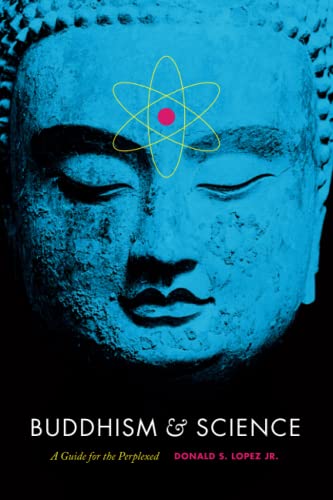
Ebook Info
- Published: 2010
- Number of pages: 264 pages
- Format: PDF
- File Size: 2.90 MB
- Authors: Donald S. Lopez Jr.
Description
Beginning in the nineteenth century and continuing to the present day, both Buddhists and admirers of Buddhism have proclaimed the compatibility of Buddhism and science. Their assertions have ranged from modest claims about the efficacy of meditation for mental health to grander declarations that the Buddha himself anticipated the theories of relativity, quantum physics and the big bang more than two millennia ago. In Buddhism and Science, Donald S. Lopez Jr. is less interested in evaluating the accuracy of such claims than in exploring how and why these two seemingly disparate modes of understanding the inner and outer universe have been so persistently linked. Lopez opens with an account of the rise and fall of Mount Meru, the great peak that stands at the center of the flat earth of Buddhist cosmography—and which was interpreted anew once it proved incompatible with modern geography. From there, he analyzes the way in which Buddhist concepts of spiritual nobility were enlisted to support the notorious science of race in the nineteenth century. Bringing the story to the present, Lopez explores the Dalai Lama’s interest in scientific discoveries, as well as the implications of research on meditation for neuroscience. Lopez argues that by presenting an ancient Asian tradition as compatible with—and even anticipating—scientific discoveries, European enthusiasts and Asian elites have sidestepped the debates on the relevance of religion in the modern world that began in the nineteenth century and still flare today. As new discoveries continue to reshape our understanding of mind and matter, Buddhism and Science will be indispensable reading for those fascinated by religion, science, and their often vexed relation.
User’s Reviews
Editorial Reviews: About the Author Donald S. Lopez Jr. is the Arthur E. Link Distinguished University Professor of Buddhist and Tibetan Studies in the Department of Asian Languages and Cultures at the University of Michigan.
Reviews from Amazon users which were colected at the time this book was published on the website:
⭐This book illustrates how Buddhism has religious elements that are IRRECONCILABLE with science. [If you have iTunes, look up “Saturday Morning Physics,” and you can see a lecture on “Buddhism and Science” by Donald Lopez which is not quite a condensation, but perhaps an introduction to this book].When I first saw this book, I just assumed that it would be about how Buddhism and science are complementary, since most similarly titled books are. If you’re a practicing Buddhist, or have a beginning interest in Buddhism, I’m not sure whether to recommend this book or not, because Lopez is to Buddhism what Bart D. Ehrman is to Christianity, i.e. Lopez has a purely academic interest in Buddhism, and is the opposite of an evangelist; whether intentionally or not, he discourages belief in Buddhism. What he says is technically true, but if you’re a Buddhist, this book is painful to read. On the plus side (counter-intuitively, perhaps), this book has pushed me to an openness to the more “supernatural” aspects of Buddhism.In this book, Lopez looks at representative Buddhists from the past hundred or so years who attempted to reconcile Buddhism with science: Anagarika Dharmapala (1864-1933, Sri Lanka), Taixu (1890-1947, China), Shaku Soen (1859-1919, Japan), Gendun Chopel (1903-1951, Tibet), and the Dalai Lama (b. 1935, Tibet).In the first chapter, Lopez points out that, in Buddhist cosmology, there is a mountain in the center of the world/universe, Mount Meru. Each of the aforementioned Buddhists attempt to reconcile this belief with science. Dharmapala, for instance, “refutes” the Newtonian view as being incorrect. Taixu attempts to reinterpret Mount Meru as a metaphor. Also in this chapter, the fact that the Buddha claimed the world was flat also poses problems for the aforementioned Buddhists.In the second chapter, “Scientific Racism” enters the picture. If you’re familiar with the history of science, you’ll know that Darwin’s idea of natural selection and competition between races, for almost a hundred years, was interpreted as justifying racism, so much so that scientists claimed that non-whites were inherently inferior. This dovetails into an idea that is prevalent in 19th and early 20th century academia that, early in India’s history, it had been invaded by a race calling themselves Aryans, and since Sanskrit is part of the Indo-European language family, Europeans therefore saw the Buddha as being, in a very real sense, racially equal. So, for example, Taixu in 1937 writes a letter to Hitler that, since the Germans are Aryans, they should adopt a religion founded by an Aryan: Buddhism. Now, Lopez notes that Taixu was very likely unaware of Hitler’s agenda, and I agree that Taixu innocently bought into the then current “scientific” thinking.I won’t summarize the whole book, but you get the gist of what Lopez is getting at. Science is subject to revision, and so any claims of being in sync with science are going to be provisional and shifting.In a footnote on page 235, Lopez quotes Hermann Oldenberg: “But any one who attempts to describe Buddha’s labours must, out of love for truth, resolutely combat the notion that the Buddha [was attempting the] reformation of national life.” That phrase “out of love for truth” I think is applicable to Lopez, I believe that it is his impetus for writing this book. Lopez once described his anthology “Buddhism in Practice” as being “a necessary corrective,” and I think that too is applicable here.I agree and disagree with Lopez’s conclusions. Lopez doesn’t go back far enough in history to mention that, when Buddhism entered China, for instance, it lost elements and gained elements: Buddhist missionaries omitted offensive concepts, and aspects of Indian tradition that were congenial to Chinese tastes were emphasized; influenced by Daoism, nature became an important concept in Chinese Buddhism as it never had been in India; Chinese social values emphasized family, so the bodhisattva Vimalakirti, for example, became a model of a sage who maintained his loyalty to the family while pursuing the path of the Buddha; none of the schools that were major in China had been major in India. Is the influence of science on Buddhism less valid than the influence of Daoism and Chinese culture on Buddhism?At the same time, I am against scientism, i.e. the view that natural science has authority over all other interpretations of life, such as philosophical, religious, mythical, spiritual, or humanistic explanations. There are some questions that science hasn’t figured out yet, and maybe those questions will eventually be answered, or maybe they never will. In conjunction with Lopez’s book, I would recommend reading David Berlinski’s “The Devil’s Delusion: Atheism and its Scientific Pretensions”. I think that it’s interesting that we live in an age where almost every view has to be reconciled with science, that we live in an age of “scientific pretensions.”I think that Buddhism is an eminently valuable philosophy and practice. I, for one, like the current climate of Buddhism’s openness to a dialogue with science, in spite of the checkered history of the dialogue that Lopez has pointed out. The best impact this book could have would be an acknowledgment of, and honesty about, that history.
⭐In my opinion, rather than being “a guide to the perplexed”, this book provides an inaccurate impression of Buddhism.First of all, the beginning quote presumed to be by Einstein in the Introduction is a set up for a “sucker punch” in the following page. Actually, there is now a published booklet entitled, “Einstein on Cosmic Religion and Other Opinions and Aphorisms” (Dover, 2009) on essays of Einstein. On page 48, “…Indications of this cosmic religious sense can be found even on earlier levels of development – for example, in the Psalms of David and in the Prophets. The cosmic element is much stronger in Buddhism, in particular; Schopenhauser’s magnificent essays have shown us”.It was such a surprise to me (being a Theravada Buddhist) that a complete chapter (the first chapter) is a discussion on a mythical Mount Meru, since I was not even aware of a Mount Meru. Even though I was born a Buddhist, I must admit that had not spent much time seriously studying Buddhism until a year ago. I have been reading up on Abhidhamma (the fundamental or higher dhamma) for a year, and it seems to me Buddhism is more compatible with science than any other religion. There are many “add-ons” to Buddhist literature from other religions and other national myths (Chinese, Japanese, and Tibetan) that needs to be weeded out by the interested reader. However, in all these various forms of Buddhism, the cornerstone principles of the Four Noble Truths and Eight Noble Path remain the same.The second chapter is on “science of race”. What has race to do with science? Regardless of what certain Buddhists (even in high positions) may have done or said, it is quite clear that the Buddha considered all human beings at the same level. As the author himself points out, the Buddha stated that, “one is a noble (whether stated as ariya or brahmin), depending on his deeds and not on birth”. Furthermore, “ariya” in Buddhism refers to noble and pure and it has nothing to do with race. The cornerstone of Buddhism is the Four Noble Truths (Cattari Ariyasaccani), where ariyasaccani is noble truths.For the readers interested in learning about Buddha’s message, I recommend “What the Buddha Taught”, by Walpola Rahula, and at a bit more deeper level, “In the Buddha’s Words” by Bhikkhu Bodhi. On mediation, “Mindfulness in Plain English” by Bhante Henapola Gunaratana will clarify to the reader that there is nothing mystique about Buddhist meditation. It is amazing to see that the author has quoted a relatively insignificant paper by Walpola Rahula Thera, and did not even refer to his above highly-praised book (interested readers can look up Amazon reviews on these books).Buddhism is all about the mind and consciousness. The readers can make up their own mind whether Buddhism offers something useful for the mankind or whether it is a mythical religion as this book attempts to convey. I believe that the Buddha’s words will gain more credence with each scientific discovery, especially in quantum mechanics where it is beginning to show the relevance of consciousness. By the way, the Buddha did not directly address questions on the cosmos, but there are two things that are quite clear from his teachings:1. since the rebirth process (samsara) has no beginning, there is no traceable beginning to life (universes may come into being and eventually be destroyed, but life will always be there). The topic of multiple universes is now being seriously discussed by the scientists.2. The sentient beings can be born with consciousness in four different planes of existence, but the Buddha did not say where they are located. The newest string theory (M-theory) says our universe is 11-dimensional, and we can observe only four dimensions; so there maybe other dimensions that we cannot access. It is also quite possible that life exists on other planets in this universe and may be in other parallel universes as well. The Buddha did not want people to spend time on the nature of the physical universe (see the above books), but wanted them to focus on the mind and moral behavior. He clearly stated that mind is the primary architect, and matter is secondary.The above two are examples of what I was expecting to be discussed in a book entitled “Buddhism and Science”.
⭐Lopez does a stellar job at giving the context and complicating the assumptions behind modern interpretations and myths around Buddhism. His foray here into Buddhism and Science is particularly interesting focusing on both Western engagements and engagements in Asia and the creation of “Buddhist Modernism” in both Asia and the US through the 19th and 20th centuries and dipping into the 21st. Lopez picks representatives of Sri Lankan, Chinese, Tibetan, and Japanese adaptions to science as well as Orientalist narratives about it and the current discourse around the Dalai Lama and his role in Buddhist modernism. Some has said Lopez does not let science speak for itself and capitalizes it as if it is an equal discourse on religion, but it appears to me that Lopez is pointing out that concepts of science being applied to Buddhism are not “science” as practiced at the moment and more science as abstraction divorced from practice. Strongly recommended.
⭐A great read for anyone who wants to learn more about what the Buddha actually taught and what he means. So many schools of Buddhism have interpreted the original teachings to accommodate their spiritual perspectives, Lopez clears this up. Just so you know, there are many Buddhists who are a bit upset at Lopez.
⭐A well researched and presented thesis on the evolution of Buddhism in contemporary science. Though there is a shortage of actual science, this book discusses how Buddhism has evolved into a relevant method of interpreting contemporary life.Well worth the read.
⭐The best book on Buddhism in comparative religions I have read. Extremely thorough and beautifully written.
⭐You may have come across books claiming to reconcile Buddhism with modern cosmology, quantum physics or psychology and wondered how credible these books are from a scientific or Buddhist perspective. Much might depend on whether they are written by Buddhists with a scientific interest or scientists with a Buddhist interest. Dr Lopez is neither, he is an academic historian of Buddhist and mainly Tibetan Buddhist thinking. This is a very scholarly look at some of the early interactions between Buddhist thinkers and Westerners. One point he makes consistently in the book is that Buddhism received the reputation for being scientific, logical and accommodating scientific discoveries often when the Westerners making those statements knew very little about Buddhism and few traditional Buddhists in Asian countries knew much about Western science. Likewise given that science changes over time, it can be difficult to see what precisely which scientific thinking Buddhism accommodates. Dr Lopez seems surprised that Buddhists in Tibet who first encountered Western science had some fairly strange interpretations of whatever science was salient in their day. The idea espoused in many schools, that when a Buddhist finds themselves holding an idea that can be shown to be untrue no matter how deeply cherished, that view is to be abandoned, does not get aired. He outlines how some Asian Buddhists clung to traditional cosmologies long after the Western scientific view had prevailed elsewhere but gives little sense as to whether this was a “counter reformation” movement in Buddhism or just a few conservatives holding out against change. This section of the book seemed a bit of a “straw man” argument. Strangely, he largely ignores the most prominent overlap between scientific and Buddhist thinking in the area of mental health and neuroscience with the burgeoning field of mindfulness research, which is putting Buddhist claims for meditation to rigorous scientific evaluation. If you buy this book hoping to have your perplexity reduced you might be disappointed. The core message of the book is that Buddhist thinking has changed over time and he tries to put some ideas in their proper historical context. It is an interesting perspective on the history of the meeting of two cultures and dispels a few myths.
⭐Good book. Thank you
⭐I would like to start off by saying this book is a total misnomer. There is nowhere near as much information on Buddhism and actual science as there is on ‘the science of Buddhism’ and ‘race science ‘ which aren’t actually sciences at all but academic studies. This is frustrating for a science and society student – if you want a book that explains biology/chemistry/physics and Buddhism you’re wasting your time with most of this book. There are some sections that are interesting and informative on the Buddhism-science relationship but this is the minority. This should be made much clearer: the book should most certainly have a different title or a blurb which explains this. The book is mostly the history of the study of Buddhism with a little science thrown in here and there. As I said, the scientific points are interesting and were useful to me, but there should have been a lot more of them to merit this title.I found the writing style quite hard to decipher as the sentences run on and some become quite convuluted. Many have to be read several times to be understood. This is coming from a native English speaker who has no trouble understanding Shakespeare.All in all, some useful points but mostly useless to me and rather poorly written/edited. Not what I expected at all.
Keywords
Free Download Buddhism and Science: A Guide for the Perplexed (Buddhism and Modernity) in PDF format
Buddhism and Science: A Guide for the Perplexed (Buddhism and Modernity) PDF Free Download
Download Buddhism and Science: A Guide for the Perplexed (Buddhism and Modernity) 2010 PDF Free
Buddhism and Science: A Guide for the Perplexed (Buddhism and Modernity) 2010 PDF Free Download
Download Buddhism and Science: A Guide for the Perplexed (Buddhism and Modernity) PDF
Free Download Ebook Buddhism and Science: A Guide for the Perplexed (Buddhism and Modernity)