Ebook Info
- Published: 2008
- Number of pages: 264 pages
- Format: PDF
- File Size: 1.42 MB
- Authors: Donald S. Lopez Jr.
Description
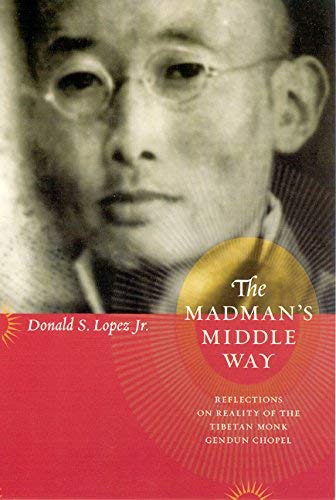
Gendun Chopel is considered the most important Tibetan intellectual of the twentieth century. His life spanned the two defining moments in modern Tibetan history: the entry into Lhasa by British troops in 1904 and by Chinese troops in 1951. Recognized as an incarnate lama while he was a child, Gendun Chopel excelled in the traditional monastic curriculum and went on to become expert in fields as diverse as philosophy, history, linguistics, geography, and tantric Buddhism. Near the end of his life, before he was persecuted and imprisoned by the government of the young Dalai Lama, he would dictate the Adornment for Nagarjuna’s Thought, a work on Madhyamaka, or “Middle Way,” philosophy. It sparked controversy immediately upon its publication and continues to do so today. The Madman’s Middle Way presents the first English translation of this major Tibetan Buddhist work, accompanied by an essay on Gendun Chopel’s life liberally interspersed with passages from his writings. Donald S. Lopez Jr. also provides a commentary that sheds light on the doctrinal context of the Adornment and summarizes its key arguments. Ultimately, Lopez examines the long-standing debate over whether Gendun Chopel in fact is the author of the Adornment; the heated critical response to the work by Tibetan monks of the Dalai Lama’s sect; and what the Adornment tells us about Tibetan Buddhism’s encounter with modernity. The result is an insightful glimpse into a provocative and enigmatic workthatwill be of great interest to anyone seriously interested in Buddhism or Asian religions.
User’s Reviews
Reviews from Amazon users which were colected at the time this book was published on the website:
⭐After years and years, after studying each verse, within each chapter, with dictionary in tow, along comes Gendun Copel and his important and seminal work. Important because Gendun moves to the front of the line, with boldness, and states the case clearly, exactly as Nagarjuna enunciated. Please, don’t let Gelug reformists and, especially, the American interpretationists (i.e, Garfield) detract you. No, my good friends, Chopel makes it clear and unambiguous. If you suspected what Nagarjuna stated was pointing to the inconceivable Truth, however unbelievable others may make it may appear, never fear: Chopel comes in with clarifying footnotes: yes, you were right all along. Now you are unfettered to take the next step: actualizing the Truth in your lives and nevermind the intellectual naysayers. Thank you, Gendun, thank you; why did we have to wait so long? Why?
⭐A translation that gives great insight into this original thinker’s approach.
⭐I liked the comprehensive introduction to GC. It is generally for philosophically oriented minds with some exposure/interest in Buddhist philosophy.
⭐I have purchased this book (and given them away) several times already. One of the most profound readings I have ever had!
⭐By far, the worst commentary I have ever read on the Madhymaka.Chopel appears to be very overrated and the authors descrition of his life and teachings us mundane and dreadfully boring.
⭐The book gives more a more detailed account of the life of Gendun Chopel and his significance to Buddhism and Tibet than the film “Angry Monk”. Both the film and the book make great companions, however.
⭐Nagajuna’s work is notoriously difficult to grasp but I found Chopel’s text and commentary much easier to negotiate than the other translations I have tried. The main reason appears to be Chopel’s transparent prose. He has such a profound understanding of Nagajuna’s work that his interpretation gets right to the essentials and doesn’t let translational difficulties get in the way. At times it seemed Nagajuna was addressing the reader directly and something of the master’s force of character came through the barriers of another language and another age. I would recommend this text for both beginners and the more experienced student for precisely the reasons I have given – it has made a difficult work more accessible to the general reader and seems to reach across a gulf of time to make Najajuna less a figure of myth and legend than a thinker engaged in questions that are still very much alive today. The account of Chopel’s short but full life is also of great interest but of lesser interest to me than how he managed to bring the words of a long-dead master to life.
⭐It is rare to find someone in any field who is fully expert in their subject and also able to explain it well to others. Gedun Chophel was a master of philosophy, language, poetry, and above all, an open thinker. This book is special in that there are few if any people who can explain the true Madhyamika view beyond assertions. Gedun Chophel not only leads you there, but refutes possible mistakes and uses the debate style employed in the Gelugpa monasteries to explain the subtle views of Madhyamika that are not often found outside the context of Mahamudra. This text is tremendously difficult, but worth every effort. I hope many will read this and find it of benefit. The root text is translated well, but I did not find the commentary helpful in the least.
Keywords
Free Download The Madman’s Middle Way: Reflections on Reality of the Tibetan Monk Gendun Chopel (Buddhism and Modernity) in PDF format
The Madman’s Middle Way: Reflections on Reality of the Tibetan Monk Gendun Chopel (Buddhism and Modernity) PDF Free Download
Download The Madman’s Middle Way: Reflections on Reality of the Tibetan Monk Gendun Chopel (Buddhism and Modernity) 2008 PDF Free
The Madman’s Middle Way: Reflections on Reality of the Tibetan Monk Gendun Chopel (Buddhism and Modernity) 2008 PDF Free Download
Download The Madman’s Middle Way: Reflections on Reality of the Tibetan Monk Gendun Chopel (Buddhism and Modernity) PDF
Free Download Ebook The Madman’s Middle Way: Reflections on Reality of the Tibetan Monk Gendun Chopel (Buddhism and Modernity)