Ebook Info
- Published: 2011
- Number of pages: 512 pages
- Format: PDF
- File Size: 3.81 MB
- Authors: Christopher I. Beckwith
Description
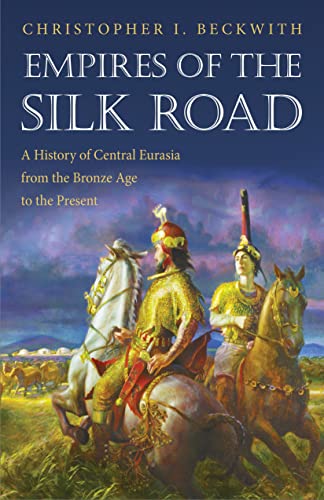
The first complete history of Central Eurasia from ancient times to the present day, Empires of the Silk Road represents a fundamental rethinking of the origins, history, and significance of this major world region. Christopher Beckwith describes the rise and fall of the great Central Eurasian empires, including those of the Scythians, Attila the Hun, the Turks and Tibetans, and Genghis Khan and the Mongols. In addition, he explains why the heartland of Central Eurasia led the world economically, scientifically, and artistically for many centuries despite invasions by Persians, Greeks, Arabs, Chinese, and others. In retelling the story of the Old World from the perspective of Central Eurasia, Beckwith provides a new understanding of the internal and external dynamics of the Central Eurasian states and shows how their people repeatedly revolutionized Eurasian civilization. Beckwith recounts the Indo-Europeans’ migration out of Central Eurasia, their mixture with local peoples, and the resulting development of the Graeco-Roman, Persian, Indian, and Chinese civilizations; he details the basis for the thriving economy of premodern Central Eurasia, the economy’s disintegration following the region’s partition by the Chinese and Russians in the eighteenth and nineteenth centuries, and the damaging of Central Eurasian culture by Modernism; and he discusses the significance for world history of the partial reemergence of Central Eurasian nations after the collapse of the Soviet Union. Empires of the Silk Road places Central Eurasia within a world historical framework and demonstrates why the region is central to understanding the history of civilization.
User’s Reviews
Editorial Reviews: Review “Winner of the 2009 PROSE Award in World History & Biography/Autobiography, Association of American Publishers””Christopher I. Beckwith, professor of Central Eurasian studies at Indiana University, suggests in his recent book, Empires of the Silk Road (Princeton University Press), that ‘the most crucial element’ of societies all through Central Eurasia–including the ones analyzed by this exhibition–was the ‘sociopolitical-religious ideal of the heroic lord’ and of a ‘war band of his friends’ that was attached to him and ‘sworn to defend him to the death.’ This idea, he suggests, affected the organization of early Islam as well as the structure of Tibetan Buddhist devotion. In fact, this ‘shared political ideology across Eurasia,’ Mr. Beckwith suggests, ‘ensured nearly constant warfare.’ The region’s history is a history of competing empires; trade became part of what was later called the Great Game.”—Edward Rothstein, New York Times”[T]his is no mere survey. Beckwith systematically demolishes the almost universal presumption that the peoples and powers of Inner Asia were typically predatory raiders, and thus supplied themselves by extracting loot and tribute from more settled populations. . . . With his work, there is finally a fitting counterpart to Peter B. Golden’s magnificently comprehensive An Introduction to the History of the Turkic Peoples: Ethnogenesis and State Formation in Medieval and Early Modern Eurasia and the Middle East, based on Arabic, Hebrew, Persian, Greek, Latin, and European medieval sources. By reading just two books anyone can now sort out Charlemagne’s Avar Ring, the Golden Horde, modern Kazakhs and Uzbeks, ancient Scyths, Borodin’s Polovtsian dances (they were Cumans), present-day Turks, Seljuks, Ottomans, early Turks, and Bulghars and Bulgarians, among many less familiar states or nations.”—Edward Luttwak, New Republic”[E]rudite and iconoclastic, [Empires of the Silk Road] provides a wealth of new ideas, perspectives, and information about the political and other formations that flourished in that large portion of the world known as Central Eurasia. . . . [A] major contribution to Central Eurasian and world history.”—Nicola Di Cosmo, Journal of Global History”[T]his volume is certain to provoke lively discussion across the field.”—Scott C. Levi, American Historical Review”This book demands our attention and will stimulate interest and debate in many circles. The author is to be congratulated on a book that is both thoughtful and provocative in its call for a reassessment of Central Eurasia and its role in world history.”—Michael R. Drompp, Journal of Asian Studies”In the process of illuminating this essential piece of the human past, Beckwick constructs a scrupulously researched narrative that is wholly accessible, and demands close attention.”—Nicholas Basbanes, FineBooksMagazine.com”[Beckwith] is quite a feisty writer, as in his hot-tempered preface excoriating post-modern thought. . . . Prof. Beckwith is one of those scholars whose almost innumerable footnotes can be relished for their wonderfully obscure detail.”—George Fetherling, Diplomat & International Canada”Beckwith is the first to have carried off the feat of actually writing a history of this whole expanse of time and space in a way stimulating enough to make the reader think about it from start to finish. There is certainly something heroic about that, and this book deserves therefore to go into paperback very much as it is, uncompromised by any retractions that may be forced upon its author by others.”—T. H. Barrett, Bulletin of the School of Oriental and African Studies”The result of a lifetime’s work on Central Asia and a complete overturning of many of our preconceptions. . . . Essential.”—Hugh Andrew, Glasgow Herald”Beckwith’s arguments are persuasive, and backed by considerable empirical evidence. He is scrupulous about noting where the evidence is murky and noting where further research is needed. Beckwith provides an interesting Central Eurasian perspective on world history. . . . Empires of the Silk Road is work that any scholar who seeks to write about Central Eurasia will need to address closely. It is a benchmark–indeed a high one–for Central Eurasian, and indeed, world history.”—Thomas D. Hall, Cliodynamics”Empires of the Silk Road is never boring, despite its involved detail. I would recommend it to anyone with enough of a background in world history and linguistics to be able to cope with a mix of outright speculation, grounded contrarianism, and straightforward history, and willing to pass over, or be entertained by, chunks of politico-aesthetic moralising.”—Danny Yee, Danny Reviews”Beckwith, like the nomadic warriors he so admires, does not shy from a battle; indeed he seems to take delight in aggressive verbal swordplay. Many readers will be disappointed or even offended by his choices and preferences, and he will surely not mind in the least. His arguments in any case have the merit of inviting engagement, and his curmudgeonly writing style makes for an entertaining reading experience whether one agrees with his assessments or not. All in all, this book is a must read for students of world history.”—Richard Foltz, Journal of World History”This is an interesting readable book, and one that keeps the reader’s interest through all of its 472 pages. . . . It is not by any means an encyclopaedia but the author is very thoughtful, and the book is a creative whole, and for this view alone the book is worth our attention, but with the extensive appendices and endnotes a place should be found for it in our libraries.”—Roger Bantock, Middle Way Review “Empires of the Silk Road is a major scholarly achievement. This is the first book to provide a comprehensive account of the history of Central Eurasia from the Bronze Age to the present. But it is much more than a simple narrative of events in what is arguably the most important region for the development of civilization during the past four or five millennia. It is an intellectually ambitious undertaking that attempts to account for essential transformations in the cultural, economic, and political life of societies situated both within the Central Eurasian heartland and on its periphery. Beckwith achieves the radical feat of demonstrating how Central Eurasia is actually key for understanding the dynamics of human history and progress throughout antiquity, the medieval period, and the recent past. Above all, and for the first time, he convincingly shows that Central Eurasia was not a sump of poverty-stricken, unremittingly vicious subhumans, but a wellspring of vibrant, energetic, resourceful, enterprising peoples who facilitated communication and change in all directions. In other words, Beckwith turns conventional wisdom on its head and makes Central Eurasia the core of human history, rather than the embarrassing backwater which it is usually portrayed as. Perhaps his greatest contribution is in the powerful, sustained epilogue, where he shatters a whole galaxy of misconceptions about the dreaded ‘barbarians.'”―Victor H. Mair, University of Pennsylvania”Ambitious, provocative, and bristling with new ideas, Empires of the Silk Road will set off sparks. The book’s clearly articulated themes are lively and stimulating, and Beckwith’s integration of European, Central Asian, and East Asian materials makes this a major work in Eurasian and world history. In range and depth, this readable book is quite unlike any other.”―Peter B. Golden, Rutgers University”Empires of the Silk Road is a major scholarly achievement. . . . Beckwith turns conventional wisdom on its head and makes Central Eurasia the core of human history, rather than the embarrassing backwater which it is usually portrayed as.”―Victor H. Mair, University of Pennsylvania From the Back Cover “Empires of the Silk Road is a major scholarly achievement. This is the first book to provide a comprehensive account of the history of Central Eurasia from the Bronze Age to the present. But it is much more than a simple narrative of events in what is arguably the most important region for the development of civilization during the past four or five millennia. It is an intellectually ambitious undertaking that attempts to account for essential transformations in the cultural, economic, and political life of societies situated both within the Central Eurasian heartland and on its periphery. Beckwith achieves the radical feat of demonstrating how Central Eurasia is actually key for understanding the dynamics of human history and progress throughout antiquity, the medieval period, and the recent past. Above all, and for the first time, he convincingly shows that Central Eurasia was not a sump of poverty-stricken, unremittingly vicious subhumans, but a wellspring of vibrant, energetic, resourceful, enterprising peoples who facilitated communication and change in all directions. In other words, Beckwith turns conventional wisdom on its head and makes Central Eurasia the core of human history, rather than the embarrassing backwater which it is usually portrayed as. Perhaps his greatest contribution is in the powerful, sustained epilogue, where he shatters a whole galaxy of misconceptions about the dreaded ‘barbarians.'”–Victor H. Mair, University of Pennsylvania”Ambitious, provocative, and bristling with new ideas, Empires of the Silk Road will set off sparks. The book’s clearly articulated themes are lively and stimulating, and Beckwith’s integration of European, Central Asian, and East Asian materials makes this a major work in Eurasian and world history. In range and depth, this readable book is quite unlike any other.”–Peter B. Golden, Rutgers University”Empires of the Silk Road is a major scholarly achievement. . . . Beckwith turns conventional wisdom on its head and makes Central Eurasia the core of human history, rather than the embarrassing backwater which it is usually portrayed as.”–Victor H. Mair, University of Pennsylvania About the Author Christopher I. Beckwith is Distinguished Professor of Central Eurasian studies at Indiana University, Bloomington, and the recipient of a MacArthur Award. He has published extensively on Central Eurasian history and linguistics, including The Tibetan Empire in Central Asia: A History of the Struggle for Great Power among Tibetans, Turks, Arabs, and Chinese during the Early Middle Ages (Princeton,1987/ revised ed. 1993), Koguryo, Language of Japan’s Continental Relatives (Brill 2004/ 2nd ed. 2007), Phoronyms: Classifiers, Class Nouns, and the Pseudopartitive Construction (Peter Lang, 2007), Warriors of the Cloisters: The Central Asian Origins of Science in the Medieval World (Princeton, 2012), and Greek Buddha: Pyrrho’s Encounter with Early Buddhism in Central Asia (Princeton, 2015). Read more
Reviews from Amazon users which were colected at the time this book was published on the website:
⭐recounting the history of what the author terms ‘Central Eurasian [henceforth CEA] Culture Complex,’ which – geographically speaking – spread from Manchuria and the Korean Peninsula (i.e., Koguryo kingdoms) in the East to as far as the Pannon Plain/Carpathian Basin in the West, and in some respects even beyond those frontiers. One of the central themes connecting diverse peoples in this diachronic-synchronic/vertical-horizontal study is the presence of the oath-sworn guard corps (Latin ‘comitatus’) that gradually grew in number and formed the heart of CEA nations until the adoption of world religions in the Middle Ages (p. 15 passim). Maintaining the steady flow of luxury goods so as to reward their services played no small part as the raison d’etre for commerce along the Silk Road.You can read about the war charioteer Hittites, Ashvins/Wu-sun-s, Mycaneans; the state foundation struggles regarding Scythians vs. Cimmerians, Hsiung-nu-s vs. Tokhars, Huns vs. Goths, Turks vs. Avars, Mongols vs. Jurchens; as well as about the Arab conquest in Central Asia, the Khazar kaganate, imperial Tibet, Uighurs, and sundry. By extending the analysis to maritime-based trade (littoral systems) and subsequent European (Portuguese, Dutch, British, Russian) expansion/colonization in Asia, the Orientalist scholar may have cast his net far too wide. Nowhere is this more apparent than in the last two chapters (pp. 263-319, concerning 19-20th centuries), which, as other reviewers have already noted, are way too sketchy, overly generalizing, at times propagandistic, and even off tangent. Don’t ask me what importance T.S. Eliot’s “The Waste Land” or Stravinsky’s “The Rite of Spring” holds for CEA history. Rather, the author could have breathed a word or two, say, about the Manchu-Chinese/Tibetan conflict vis-á-vis the Gurkha-ruled Nepal, the Opium Wars, the Crimean War, the ‘Great Game’ b/w Russia and Britain for the control of Central (and Inner) Asia, etc.Nitpicking or not, allow me to make a slight correction at this point w/ regard to the following assertion: “[After the demise of the Sakyapa overlordship, circa 1357, w]ith the partial exception of brief interregnum periods, Tibet continued to be largely unified under the rule of one or another Mongol state down to the defeat of the Junghars by the Manchu-Chinese (p. 258 fn. 80).” This is clearly untrue. There was almost zero Mongol influence in Central Tibet (ÜTsang), let alone their central authority, during the Pakmodrupa priest-kings (1358-, nominally, 1618) and the Rinpungpa governors/castellans (roughly, 1491-1566). Under the reign of the Tsangpa rulers (1567-1642) certain Tibetan factions, mainly but not exclusively the Gelukpas, sought contact w/ various Mongol tribes in order to secure their military aid. The Mongols’ role during the early stage of the Dalai lama’s regime (1642-1720) was that of a hired sword to subdue internal and external opposition.The main corpus is best read simultaneously with the endnotes, of which there are 111 (pp. 385-426), that offer some real insights and marshal relevant evidences. The same is true for the epilogue entitled ‘The Barbarians’ (pp. 320-62), which goes a long way to dispel a host of long-held misconceptions, and the two appendices (‘The Proto-Indo-Europeans and their Diaspora,’ pp. 363-74; ‘Ancient Central Eurasian Ethnonyms,’ pp. 375-84). As a methodological tool, turning the ruling paradigm of centre-periphery inside out facilitates bringing some well-deserved ‘historical justice’ to this marginalized region in crucial observations, such as:+ “In every recorded case when the traditional Graeco-Roman, Persian, or Chinese empires of the periphery [!] became too powerful and conquered or brought chaos to the Central Eurasian nomadic states, the result for Central Asia, at least, was economic recession. The Han Dynasty destruction of the Hsiung-nu resulted in chaos…it was several centuries before the Türk, the next nomadic people who understood the Silk Road, could restore the system…When the Chinese and Arab alliance against Tibetans and the Western Turkic empire…succeeded…the result was chaos…, bringing with it severe recession, followed by rebellions and revolutions led by Sogdians and other merchant people [740-60s CE] that affected most of the continent. Finally, when the Manchu-Chinese and Russians partitioned Central Eurasia and the Ch’ing Dynasty destroyed the Junghar Empire [1755]…the economic devastation they wrought…was so total that even at the turn of the millennium in AD 2000 the area had not recovered (pp. 257-8).”+ “There was a constant drain of people escaping from China into the realms of the Eastern Steppe, where they did not hesitate to proclaim the superiority of the nomadic life-style. Similarly, many Greeks and Romans joined the Huns…where they lived better and were treated better (p. 76).”+ The primary goal of fortifications along the borders of peripheral empires from China through Persia to Rome (‘limes’ network or the Byzantine military governorships called ‘theme’) was offensive in nature, “to hold territory conquered from neighbouring states and to prevent loss of population to them (p. 330).”+ “[T]he vast majority of the silk possessed by the Central Eurasians in the two millennia from the early Hsiung-nu times [4-3rd c. BCE] through the Mongols down to the Manchu conquest was obtained through trade and taxation, not war or extortion (p. 23).”+ Raids of steppe people were, in many cases, triggered by the breaches of treaties, or were made at the request of some peripheral power against local enemies (divide et impera), e.g., the Manchus were called upon by the Chinese Ming dynasty to crush rebellion; the Mongols’ aim was to uproot their Jurchen (Chin dynasty) adversaries (p. 335); Uighur Turks (757 CE) were invited to quell the An Lu-shan revolt — their sacking of Loyang (762) “was authorized by the financially strapped T’ang court as a reward or payment (p. 338).”For reasons unknown, the following essays by the same author of the present tome have not found their way to the bibliography (pp. 427-55): ‘Tibet and the Early Medieval Florissance in Eurasia,’ in: Central Asiatic Journal 21 (2), 1977: pp. 89-104; in collaboration w/ Michael Walter: ‘Some Indo-European Elements in Early Tibetan Culture,’ in: Tibetan Studies 7, Vol. 2: pp. 1037-54, Vienna 1997.
⭐Christopher Beckwith is a eminent scholar of Central Eurasian Studies and just as importantly, this is a rigorous book meant as a brief but comprehensive outline of Eurasian history for scholars, students, and general readers. Because of the rather neglected state of the field , this is one of the very few books available that gives a general overview of Central Eurasian history. I’m a student of Central Eurasian Studies and I’ll give my opinion but by first detailing it’s strengths.1. A excellent overview and somewhat comprehensive treatment of Eurasian history from prehistory to modern times.2. The book demystifies and sets the record straight of myths and misconceptions about Central Eurasia and its inhabitants while detailing how Central Eurasia has profoundly influenced not just its own region but also world history.3. Has a extensive bibliography for further study.4. Has many footnotes for extra vital or enlightening information.5. In the end of the book there are a few maps, appendices, and endnotes that can be helpful and informative.6. The author’s writing is clear and somewhat easy to follow.7. This work is very affordable especially for being a 500+ page book.Now for the drawbacks.1. Mostly focuses on the political and economic history of Central Eurasia (If you’re looking for a cultural and/or religious history, this may not be the book for you).2. Highly technical and academic so it’s hard to read and understand at times. The footnotes and appendices seem to meant for hardened scholars. The author seems to assume you already have a deep familiarity of the subject. This flaw might make it a struggle to read for general readers. Everyone else thread lightly.3. The book covers a very vast region so sometimes the names, locations, peoples, religions, dates and more can get overwhelming or confusing.4. This book would of benefited from illustrations, pictures and much more maps.5. Book loses focus when it reaches the early modern age and beyond. The book for some reason takes up many pages on the economic history of Southeast Asia and a odd rant about modern art and music. This and other detours make the book difficult to read at times.6. The author has a obsessive hatred for Modernism and Post-Modernism so prepare for many long-winded rants. He blames every evil in the world and critiques anything he doesn’t like by claiming it’s because of Post-Modernism without ever explaining what it is and why it’s bad. A example is Endnote 88 on page 417-8: ‘Edward Said accused Western scholars of having stolen Asian peoples’ culture by studying them. This extreme anti-intellectualism has been well criticized’. The author is clearly wrong here. What Edward Said was actually talking about is that Western scholars sometimes put their Western or Christian prejudices and bias into the history, religion, and culture of non-western civilizations so creating a possibly false (biased) view of that subject.7. Chapter 9 might be by far the worst chapter of them all. The author goes out of his way to make excuses and apologia for the brutal European dominance of the Middle East and Asia during the early modern age. Gives borderline racist excuses like saying that Europeans came and solved the crime so who cares about the bad things they did and that Europeans had laws better than that of the Middle Easterners and Asians. He also makes it sound like only Europeans had a sense of wonder and curiosity so that’s why they dominated and explored. The only good thing about the chapter is correctly criticizing Christian missionaries and their consequences on both European trade and Asian societies. These views of the author make me suspect that there is a Right-Wing bias not just in the his personal politics but also that it may spill into his scholarship (like in this book) but who knows.Ok, I’m finished. While some of the author’s points seem valid, much of his points regarding Modernism and politics are just wasting space on this book. However, the occasional loss of focus on the topic at hand and its very dry academic tone are probably the biggest flaws of the book. Nonetheless this is one of a very few books devoted to a general history of Central Eurasia but its a rather solid one at that. It’s very comprehensive and another bonus is the surprising affordability of it. The positives overweigh the negatives in my opinion. Well, I hope my review helped whether you are a scholar, student, or casual reader.
⭐Encompassing review of China Japan Korea and Vietnamese ban history starting way back like 1000bc -+. Liked the level of detail
⭐This appears to be a collection of essays somewhat cobbled together into something rather oddI believe the author does confess it began as essays and really should have handed the whole thing over to a skilled editor to give the essays background and continuity
⭐The general concept is well defined and novel enough to challenge you into rethinking much of the historical context ‘classical texts’ furnish us with about the ‘barbarian and nomad cultures of central Eurasia’. The account offered for the dilution of the comitatus principle of organisation was especially interesting.
⭐very thorough and a great deal of information. however, a bit difficult to slog through and sometimes cumbersome academic writing. more maps would have been helpful, i found myself skipping back and forth through the book trying to identify and remember key places.
⭐A heavy slog. A different viewpoint of history, not one I agree with. A disappointing read.
⭐Very good.
Keywords
Free Download Empires of the Silk Road: A History of Central Eurasia from the Bronze Age to the Present in PDF format
Empires of the Silk Road: A History of Central Eurasia from the Bronze Age to the Present PDF Free Download
Download Empires of the Silk Road: A History of Central Eurasia from the Bronze Age to the Present 2011 PDF Free
Empires of the Silk Road: A History of Central Eurasia from the Bronze Age to the Present 2011 PDF Free Download
Download Empires of the Silk Road: A History of Central Eurasia from the Bronze Age to the Present PDF
Free Download Ebook Empires of the Silk Road: A History of Central Eurasia from the Bronze Age to the Present