

Ebook Info
- Published: 2015
- Number of pages: 680 pages
- Format: PDF
- File Size: 31.19 MB
- Authors: S. Frederick Starr
Description
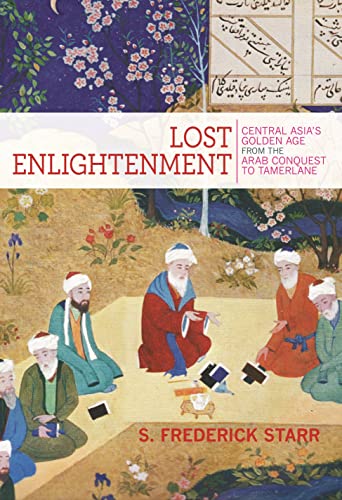
The forgotten story of Central Asia’s enlightenment―its rise, fall, and enduring legacyIn this sweeping and richly illustrated history, S. Frederick Starr tells the fascinating but largely unknown story of Central Asia’s medieval enlightenment through the eventful lives and astonishing accomplishments of its greatest minds―remarkable figures who built a bridge to the modern world. Because nearly all of these figures wrote in Arabic, they were long assumed to have been Arabs. In fact, they were from Central Asia―drawn from the Persianate and Turkic peoples of a region that today extends from Kazakhstan southward through Afghanistan, and from the easternmost province of Iran through Xinjiang, China.Lost Enlightenment recounts how, between the years 800 and 1200, Central Asia led the world in trade and economic development, the size and sophistication of its cities, the refinement of its arts, and, above all, in the advancement of knowledge in many fields. Central Asians achieved signal breakthroughs in astronomy, mathematics, geology, medicine, chemistry, music, social science, philosophy, and theology, among other subjects. They gave algebra its name, calculated the earth’s diameter with unprecedented precision, wrote the books that later defined European medicine, and penned some of the world’s greatest poetry. One scholar, working in Afghanistan, even predicted the existence of North and South America―five centuries before Columbus. Rarely in history has a more impressive group of polymaths appeared at one place and time. No wonder that their writings influenced European culture from the time of St. Thomas Aquinas down to the scientific revolution, and had a similarly deep impact in India and much of Asia.Lost Enlightenment chronicles this forgotten age of achievement, seeks to explain its rise, and explores the competing theories about the cause of its eventual demise. Informed by the latest scholarship yet written in a lively and accessible style, this is a book that will surprise general readers and specialists alike.
User’s Reviews
Editorial Reviews: Review “Honorable Mention for the 2013 PROSE Award in European and World History, Association of American Publishers””One of Choice’s Outstanding Academic Titles for 2014″”Lost Enlightenment is a remarkable and accessible scholarly tour de force.”—David Morgan, Times Literary Supplement”Starr argues rightly that the region’s brilliant culture rested on a highly cosmopolitan mix of ethnic groups, languages and religions; a long, rich pre-Islamic intellectual tradition (mainly Buddhist); and prosperity. . . . Starr shines in his core chapters, where he presents the great achievements of the Central Asian philosopher-scientists at a time when their homeland was the creative intellectual capital of the world.” ― Nature”Starr is that rare scholar with the horsepower to write about the medieval culture of this vast region that is bounded by Persia to the west, and China to the east, and India to the southeast. . . . An indispensable title for scholars, this lively study should prove equally compelling to serious lay readers with an interest in Arabic and medieval thought.” ― Library Journal”In this graceful, luxuriant history, Starr recovers the stunning contributions of Central Asia scientists, architects, artists, engineers, and historians during the four centuries that began just before the Arab onslaught of the eight century and lasted until the Mongol siege in the thirteenth century. . . . The book offers a lucid exploration of the era’s intricate philosophical and theological debates and a succinct depiction of its poetry and art, enhanced by many illustrations.” ― Foreign Affairs”Lost Enlightenment is a most amazing book, one with–if we are lucky–the potential to shape global public thinking for decades ahead. . . . Lost Enlightenment is an entirely readable, informative and even entertaining book. Although it might surely serve as an inspiration to the modern inhabitants of Central Asia, it should also serve as a warning to any modern nation and civilization that it is tempted to intolerance.”—Dimitry Chen, Asian Review of Books”Starr undertakes a daunting task–the intellectual history of Central Asia through the medieval period. Happily, he succeeds. . . . Starr’s book is thorough and well researched, and includes ample supplemental material and sources, so that even novice students will find it instructive and useful without being overwhelming.” ― Choice”This favorable account of Central Asia’s intellectual life will enhance any reader’s perception of Central Asia and challenge further investigation.”—Isenbike Togan, Bogazici Journal”This book does a marvelous job of highlighting the contributions of medieval intellectuals from Central Asia to the history of world civilizations. . . . It is a very informative and readable book.”—Richard Foltz, Fezana Journal”In the book Lost Enlightenment, historian S. Frederick Starr chronicles the long tradition of scientists, mathematicians, engineers and literary intellectuals that flourished in the Iranian- and Turkish-speaking regions of Central Asia.”—Noah Smith, Bloomberg View”This book is a must-read for those wanting to understand the development of this vast region of the world and the cultural and religious tides that gave rise to the conflicts we face today.”—Carl G. Schuster, Explorers Journal”The true value of the book is that it presents comprehensively collated data and sources, amalgamated in chronological order, about the history, culture, material life and sciences in mediaeval Central Asia, pre- and post-Islamisation. Furthermore, the author’s reasoning for the rise and decline of Central Asia’s Enlightenment is nothing short of impeccably convincing. Finally, based on the author’s arguments, one may come to appreciate the value of mediaeval Central Asia as a model for the modern world.”—Peter Nicolaus, Iran and the Caucasus”A great introduction to the ‘Scientific Golden Age.’. . . [It] provides a deep insight into the much-overlooked lands, dynasties and cultures that made up Central Asia during the Islamic Golden Age.”—Amina Smits, Insight Turkey Review “A fantastic book.”―President Ashraf Ghani of Afghanistan”Lost Enlightenment brilliantly re-creates for us the world of Central Asia, which for centuries was not a backwater but a center of world civilization. With a sure mastery of the large historical sweep as well as an eye for detail, Fred Starr has written an important book that will be a resource for years to come.”―Francis Fukuyama, author of The Origins of Political Order”For more than three hundred years the Islamic world exercised the scientific and philosophical mastery of Europe. With compelling urgency and lucidity, Lost Enlightenment tells the story of the rise and tragic demise of this golden age of Islamic learning in Central Asia. It is a story whose lesson we should never be allowed to forget.”―Anthony Pagden, author of The Enlightenment: And Why It Still Matters”From 800 to 1200, Central Asia was the world’s most advanced civilization in the sciences, mathematics, medicine, law, and art. Starr’s Lost Enlightenment thoughtfully explains this astonishing evolution and its end.”―Henry A. Kissinger”Fred Starr makes the most persuasive case yet that medieval Central Asia was a major center of civilization and high culture―and what a picture emerges.”―Richard W. Bulliet, Columbia University”Drawing on his vast knowledge and experience of Central Asia, Fred Starr provides a brilliant account of the history and culture of the land that produced some of the greatest Islamic scholars, scientists, saints, artists, and architects. Thanks to this book, the Central Asian enlightenment is no longer as lost as some might think.”―Seyyed Hossein Nasr, George Washington University”A delight to read, this is a fine survey of the intellectual and cultural history of Central Asia by a distinguished historian. By showing the remarkable discoveries in astronomy, mathematics, medicine, and other fields made by Central Asians from the earliest times, Lost Enlightenment is certain to surprise many readers by challenging traditional misconceptions of the region. The book’s biographical approach makes for lively reading. Anyone interested in the Silk Roads will find it enthralling.”―Morris Rossabi, author of The Mongols: A Very Short Introduction”This ambitious and much-needed book will be an eye-opener for many readers. S. Frederick Starr shows that Central Asia, often viewed today as a backwater, produced some of the most outstanding minds of the Middle Ages.”―Peter B. Golden, author of Central Asia in World History From the Back Cover “A fantastic book.”–President Ashraf Ghani of Afghanistan”Lost Enlightenment brilliantly re-creates for us the world of Central Asia, which for centuries was not a backwater but a center of world civilization. With a sure mastery of the large historical sweep as well as an eye for detail, Fred Starr has written an important book that will be a resource for years to come.”–Francis Fukuyama, author of The Origins of Political Order”For more than three hundred years the Islamic world exercised the scientific and philosophical mastery of Europe. With compelling urgency and lucidity, Lost Enlightenment tells the story of the rise and tragic demise of this golden age of Islamic learning in Central Asia. It is a story whose lesson we should never be allowed to forget.”–Anthony Pagden, author of The Enlightenment: And Why It Still Matters”From 800 to 1200, Central Asia was the world’s most advanced civilization in the sciences, mathematics, medicine, law, and art. Starr’s Lost Enlightenment thoughtfully explains this astonishing evolution and its end.”–Henry A. Kissinger”Fred Starr makes the most persuasive case yet that medieval Central Asia was a major center of civilization and high culture–and what a picture emerges.”–Richard W. Bulliet, Columbia University”Drawing on his vast knowledge and experience of Central Asia, Fred Starr provides a brilliant account of the history and culture of the land that produced some of the greatest Islamic scholars, scientists, saints, artists, and architects. Thanks to this book, the Central Asian enlightenment is no longer as lost as some might think.”–Seyyed Hossein Nasr, George Washington University”A delight to read, this is a fine survey of the intellectual and cultural history of Central Asia by a distinguished historian. By showing the remarkable discoveries in astronomy, mathematics, medicine, and other fields made by Central Asians from the earliest times, Lost Enlightenment is certain to surprise many readers by challenging traditional misconceptions of the region. The book’s biographical approach makes for lively reading. Anyone interested in the Silk Roads will find it enthralling.”–Morris Rossabi, author of The Mongols: A Very Short Introduction”This ambitious and much-needed book will be an eye-opener for many readers. S. Frederick Starr shows that Central Asia, often viewed today as a backwater, produced some of the most outstanding minds of the Middle Ages.”–Peter B. Golden, author of Central Asia in World History About the Author S. Frederick Starr is founding chairman of the Central Asia-Caucasus Institute & Silk Road Studies Program, a research and policy center affiliated with the Johns Hopkins School of Advanced International Studies and the Institute for Security and Development Policy in Stockholm. A past president of Oberlin College and the Aspen Institute, he began his career in classical archaeology, excavating at Gordium in modern Turkey and mapping the Persian Royal Road. Read more
Reviews from Amazon users which were colected at the time this book was published on the website:
⭐A very well written treatise whose premise that there was a central Asian period of intellectualism within the largely Muslim area that was sometimes challenged by fundamental Islam forces and ultimately destroyed by the Mongol conquest.I don’t doubt the historical accuracy of events depicted but I do take issue with his characterization of Mongol rulership. From what I know, the Mongols were actually quite keen on trade and intellectual pursuit and were tolerant of different religious beliefs. Their main goal in rulership was an economic one which was best served by allowing freedom in sciences and enterprise. They were barbaric to those who contested them but benevolent to those that recognized their rulership.Hence the end of scientific and philosophical contributions from the area are better attributed to other forces than the Mongols.
⭐This book is the culmination of a lifetime of study by the Princeton professor who wrote it, had the benefit of knowing many exotic languages, and so was almost uniquely qualified to write it. It is THOROUGHLY sourced.It is an eye-opener in portraying the reasons and geography why a brilliant urban civilization grew up around AD 1000 in the Silk Road cities of Central Asia (mostly Persian, not Arab, in ethnic/intellectual origins), achieved great advances (esp. in astronomy, mathematics, medicine, and other sciences, but yes–the poet Omar Khayyam also was there), paved the way (cast the seeds) in some ways for Europe’s own Renaissance a few centuries later, and then declined in the face of conservative religious Islamic reaction to its pursuit of knowledge outside the literal tenants of the Koran. The book sometimes gets too much into the weeds or (as regards to mathematical/astronomical achievements) too scientifically impenetrable to the layperson, but despite all that it is a window on a great story most of us do not know and of the contributions to knowledge and thought that that civilization produced and upon which, in many cases, European civilization later built. It is a significant world history chapter and Prof. Starr has provided what I suspect will long be the definitive account. Again, you’ll find a number of dry passages, but the overall theme and revelations are highly worthwhile.
⭐Complex subjects are impossible to fit in a book, but the author of Lost Enlightenment gives it a very game try. The period covered is necessarily vague but 700 CE thru 1100 would cover at least the core period with some going several centuries earlier for the beginning and/or a couple of centuries later for the ending. The area covered, Central Asia,stretches from eastern Iran to western China and on the north/south axis from the southern Russian border to that of northern India. At the crossroads of the of the world’s largest landmass Central Asia has, over time, been scene to more turmoil,traffic, technology,trade,conquest,religions,and exchange of ideas than any other comparably sized piece of real estate on the planet and those factors may have very well been the reason for its flowering. A challenging/dangerous place to live in other words but one that is fascinating to read about.It would have been easy to be overwhelmed by the plethora of places, events,and leading characters in this ambitious history. Add to that the fact that many of the dramatis personae had multiple names(birth,Arabic,known in the West as) and the potential for confusion is high. Not worrying about keeping everything straight(that’s what a second reading is for)I found that a couple of hundred pages in the locations, events,and leading characters had been repeated enough that the confusion faded. S. Starr,the author follows various subjects such as the development of specific ideas, main characters, and waves of change more than a strict time line and again this became more clear as the book developed. All this said he has done a masterful job of presenting such a complex and fascinating subject-the interplay of various factors that lead to Central Asia being the most innovative,prosperous and invigorating place on the planet for hundreds of years. The ending saddened me as the twilight approached and I realized that we may never see again such a concentrated time and place with such an immense level of vitality again. He has done his best to weave diverse/warring ideas and personalities without watering them down to tepid pablum. My thanks for such a comprehensive overview that obviously involved so much effort and research. I plan on reading it again.
⭐This is an excellent book. Very informative and very well written. After having read it, the first thing I felt like doing was reading it again. Very solid and honest scholarship by Starr. World class without a doubt. Definitely the best book I have read so far on the intellectual history of Central Asia, and I can only hope that more people will read it for its potential to sober the prevailing Western view of the region. The book lays out a wonderfully integrated narrative of a highly complex region and its similarly complex intellectual history without neither accusing nor apologizing. It is one of those books that makes you feel truly enriched after having read it, so I hereby give it my strongest recommendation to all with even the remotest interest in the subject. To my mind (and as a professional Historian) this is an example of History writing when it is best.
⭐Brilliantly written from preface to end. About the mid-Asian peoples who translated Greek science (but not Greek Drama) and Indian science and, over four centuries, lead the world in developments in Mathematics, Astronomy, Physical science, Medicine, and Business Development and Administration. Simply enthralling. In the end, it all succumbed to the ‘Strong men’ from outside, like Ghengis Khan, and (closer to home) to the reactionary men of dogma.Generally, I did not read many pages at a sitting, simply because every page is a gem. Half way through, I wondered when I would loose interest and set this big book aside. But I could NOT put it aside. To – today’s mid-Asian peoples: your antecedents inspire us all; do be sure you know this story.
⭐Having now read Lost Enlightenment several times, I can offer nothing but the highest praise for Starr and his magisterial tome. He deserves vast credit both for shining a light into a woefully under-appreciated region and era; and for having the verve and academic expertise to provide such a comprehensive yet wonderfully readable guide to the subject matter.The achievements of the scientists, philosophers and writers of the Golden Age of the title deserve to be considered in the same breath as the Golden Age of Greece and the Hellenistic World that preceded them, and the European Renaissance that followed in their footsteps. That they are not is highly unfortunate, but Starr sets about correcting that in a style that treads the right line between displaying scholarly thoroughness on the one hand and the flair of a talented popular historian on the other. This book features both the sweeping discourses necessary to familiarise the reader with a little-known period of history, and intimate snapshots, such as that following the remarkable communication between Biruni and Ibn Sina, two of the brightest stars of this age.The subject matter – ranging from mathematical and geographical advances to stylistic changes within poetry and discussions of metaphysics and logics – is diverse enough to pose a problem for an author to gather them together coherently. That Starr does so deftly, while at the same time never forgetting to tell the wider tale of the region, with its many competing religions and invading hordes, is a credit to his ability as a scholar and writer. I would recommend this book to anyone with an enthusiasm for history, science or simply learning. A marvellous book.
⭐Considering the subject topic, this is an easy book to read, however it is highly descriptive and any sort of analysis is thin on the ground. The start of the book goes on a bit about warring factions in the area and ensuing change of ruling parties, but this doesn’t really explain anything. A lot of the time there is reference to what was going on in Baghdad, but then the author consistently attributes that innovation to someone who was from Central Asia in the first instance and there the insight ends. There is some reference to the silk corridor, but then thats dismissed as any sort of explanation as to why Central Asia produced individuals who were advanced in their field. The issue is that these themes repeat themselves: its always thanks to Central Asia that science (and in fact the author is partly wrong in describing it as science) and civilisation progressed but does not explain WHY this was so. It becomes tedious because clearly this is a sweeping generalisation and in any case, Central Asia is huge so the point is mostly meaningless anyway. Disappointing as I don’t feel particularly enlightened from having read the book.
⭐This book is a revelation in opening up a new era of civilization and enlightenment of an otherwise relitavely unknown region of the world. If you are the kind of person who likes to have their breadth of knowledge enlarged and world view challenged – this is the book for you. A big yet rewarding read – the author takes you on a journey past the well known characters of Alexander the Great, Genghis Khan and Tamerlane and into the real intellectual heavyweights like Ibn Sina, Al-Buruni, Al-Bukhari and Gazhali (to name only a few) that have changed our society forever. The author goes into enough depth on each topic (that doesn’t leave you too boggled) and offers balanced and thought provoking arguments. This book will leave you feeling more enlightened and wanting to explore more of these wonderful characters in greater depth.
Keywords
Free Download Lost Enlightenment: Central Asia’s Golden Age from the Arab Conquest to Tamerlane in PDF format
Lost Enlightenment: Central Asia’s Golden Age from the Arab Conquest to Tamerlane PDF Free Download
Download Lost Enlightenment: Central Asia’s Golden Age from the Arab Conquest to Tamerlane 2015 PDF Free
Lost Enlightenment: Central Asia’s Golden Age from the Arab Conquest to Tamerlane 2015 PDF Free Download
Download Lost Enlightenment: Central Asia’s Golden Age from the Arab Conquest to Tamerlane PDF
Free Download Ebook Lost Enlightenment: Central Asia’s Golden Age from the Arab Conquest to Tamerlane