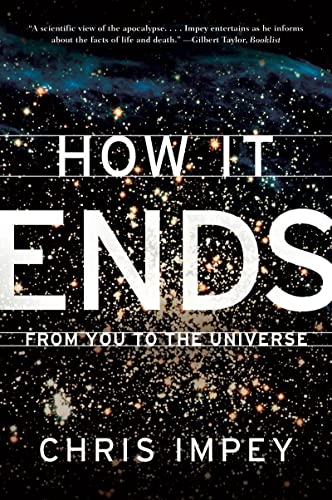
Ebook Info
- Published: 2011
- Number of pages: 354 pages
- Format: PDF
- File Size: 20.76 MB
- Authors: Chris Impey
Description
“Remarkably upbeat, and imbued with wit, wisdom and a palpable sense of awe over our universe.”―Tucson Weekly Most of us are aware of our own mortality, but few among us know what science, with insights yielded from groundbreaking new research, has to say about endings on a larger scale. Enter astronomer Chris Impey, who chronicles the death of the whole shebang: individual, species, bio- sphere, Earth, Sun, Milky Way, and, finally, the entire universe. With a healthy dose of humor, How It Ends illuminates everything from the technologies of human life extension and the evolutionary arms race between microbes and men to the inescapable dimming of the Sun and the ultimate “big rip,” giving us a rare glimpse into a universe without us. 68 black-and-white illustrations
User’s Reviews
Editorial Reviews: Review “A scientific view of the apocalypse unfolds in this tour of terminations. . . . Impey entertains as he informs about the facts of life and death.” ― Booklist”Eminently readable. . . . Impey injects humor throughout.” ― Library Journal About the Author Chris Impey is a distinguished professor in the Department of Astronomy at the University of Arizona and the critically-acclaimed author of Beyond, How It Began, and How It Ends, and four other books, as well as two astronomy textbooks. He lives in Tucson, Arizona.
Reviews from Amazon users which were colected at the time this book was published on the website:
⭐”How it Ends” is one of those books that is difficult to put down once started. It is well-written, informative, and tells a great story. It is about endings — our personal ending, the end of societies, of mankind, of animals and life on Earth, of the Earth itself, of the Solar System, the Milky Way galaxy, and finally of the universe itself. The book also addresses several ancillary issues, such as of our place in the galaxy and universe. Are we unique? Is intelligent life in the galaxy or universe special, or is it likely that intelligent life is common? Impey’s logic and arguments are both interesting and rather convincing.What impresses me most about this book is the author’s range of knowledge about the subjects being discussed, and his ability to impart it to the reader in an interesting and thoughtful manner. He brings his own reflections and experiences into the discussion, which only adds to the import of the book. There is much to reflect on while reading “How it Ends”, and I recommend it to anyone who is interested in pondering the question, what’s it all about?
⭐If you were ever curious to get an idea of how everything ends. This is THE BOOK. The author takes us through the end of human life on earth; then all life; then the end of our planet; then the end of our solar system; then the end of or galaxy; the end of our universe is next and finally the end of time, space and everything else. A great view of the distant future.
⭐This book is funny, witty and a wonderful read! I plan on reading more from this author very soon!
⭐Interesting book, good research behind.
⭐It’s awesome, I’ve always been fascinated by death and this book is incredibly interesting, I found myself submerged in it way too ofteb
⭐The book was in great condition, arrived on time, and was as interesting as stated in all the reviews. Would definitely consider future purchases from this seller.
⭐excellent!
⭐Trying to discover what happened just before or just after the farther most time point for which we just discovered what might have happened (past) or is going to happen (future) is an endless and increasingly speculative game. There are good theories on what may have happened at the Big Bang or even before; the author covered the events of the past in the book titled How It Began. Out here, he tries to sketch the future.What makes the book particularly interesting is its non-cosmological first part. The first section on the decay of any living being and individual mortality is fascinating. The book could have devoted some more space speculating whether/how in a 1000 or so years there could be human beings living hundreds of years (the topic of elongation of our lives and our existence in other forms – like digital data – is covered but rather too briefly).The sections that follow on the near future (by the cosmic standards) involve myriads of ways how our specie, the animal life on the planet and even the earth itself could go extinct. The biosphere discussions provide a more comprehensive makeover to the book before the author slips into his own area of expertise: cosmology.While the explanations/summaries are lucid and the flow is engaging, the discussions on the demise of the sun, stars, galaxies and even the universe are unlikely to add anything new to anyone who has read a handful of books on the cosmic theories. For the readers coming across the topics for the first time, the discussions of the multitudes of highly involved and complex topics could appear too perfunctory and rapid.As the author tries to describe the current scientific conjectures of the unknowable eventuality, the reader could be pardoned to feel that the lines between the theological and scientific beliefs are getting blurred. In fact, the beginning and the end increasingly look almost identical. It is a wonder that the author still mostly skips the guesses on the biggest question “why all the fuss” after unconsciously highlighting the futility of it all throughout!
⭐Excellent book, can’t put it down.
⭐This is a well written book on a topic that few of us, unfortunately, have given thought to; the end of all life as we have come to know it. Scanning death from a personal level to extinction of our species to the endpoints of evolution and to the end of the universe itself, the author does a remarkable job of making a complex topic both highly readable and informative. While the last 2/3 of the book expertly covers all aspects of cosmology and is very factual and insightful (due to the author’s professional expertise in this area), the initial chapters are less concise and well thought out. While we never should ask a candle maker to fix our shoes, and should leave that task to a cobbler, so, too, a cosmologist should not be asked to relate the events surrounding personal or species death either. His intellectual worth lies in the the knowledge of the cosmos and not in the existence of a personal soul or in what determines the individual species survival either. Get through these early disappointments because the remainder of the text is terrific!
⭐I really enjoyed this book. Really got me thinking in the last few chapters about where humankind could go. Although the more interesting part to me was what would happen on a universal scale after life would likely cease to exist. The possible outlooks and the details the Chris puts into it really captivated me. There’s a lot of ground covered in this book from the small to the immense and each chapter was enjoyable and educating.
⭐How it all ends is a fascinating look at how all things, from us to the cosmos will end. A philosophical look at science and time scales in the billions of years. If the cosmos and or physics is of any interest, you will find this an interesting and thought provoking read.
Keywords
Free Download How It Ends: From You to the Universe in PDF format
How It Ends: From You to the Universe PDF Free Download
Download How It Ends: From You to the Universe 2011 PDF Free
How It Ends: From You to the Universe 2011 PDF Free Download
Download How It Ends: From You to the Universe PDF
Free Download Ebook How It Ends: From You to the Universe