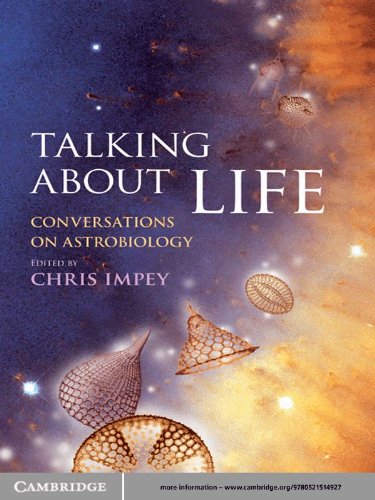
Ebook Info
- Published: 2010
- Number of pages: 419 pages
- Format: PDF
- File Size: 4.57 MB
- Authors: Chris Impey
Description
With over 500 planets now known to exist beyond the Solar System, spacecraft heading for Mars, and the ongoing search for extraterrestrial intelligence, this timely book explores current ideas about the search for life in the Universe. It contains candid interviews with dozens of astronomers, geologists, biologists, and writers about the origin and range of terrestrial life and likely sites for life beyond Earth. The interviewees discuss what we’ve learnt from the missions to Mars and Titan, talk about the search for Earth clones, describe the surprising diversity of life on Earth, speculate about post-biological evolution, and explore what contact with intelligent aliens will mean to us. Covering topics from astronomy and planetary science to geology and biology, this book will fascinate anyone who has ever wondered ‘Are we alone?’
User’s Reviews
Reviews from Amazon users which were colected at the time this book was published on the website:
⭐Top scientists share their theories and discoveries that point to the most likely places and scenarios for where life will be found and what forms it may take.These men and women have dedicated their lives to studying physics, astronomy, planetology, biology, evolution, genetics and have now begun to change their identities toastrobiologists, the newest type of science.Astrobiology is the study of life on other astral bodies than earth. The passion and depth of curiosity of these amazing people is inspiring. Some of it will be over the head of all but fellow scientists and yet, I have come away with an appreciation of the excitement in this new field. Our space program is now directing explorations with the ultimate goal of discovering life someplace else in our solar system. It has gone from being a very tentative idea a few decades ago to being a certainty among many scientists, so that Nasa is now trying to bring home samples that will prove life, most likely on Mars, Ios, Titan or Europa.All the many possibilites have been thought out and yet it is explained that all the necessary equipment that it would take to prove a life form that is not carbon and h2o based is not yet within our means to send to another planet or moon. Therefore, unless it is similar enough to our own carbon based lifeforms, we will see it and not recognize it.There is the possibility that some lifeforms might be methane and silicon based due to an abundance of these chemistries on many planets and therefore we won’t know it when we see it.It is expected that at some time, probably within the next hundred years, an outpost on Mars will be established where people will live, much as scientists now live in research stations at the Arctic.Water in the form of ice has been discovered in the past twenty years on other solar system bodies and with this, the expectation or hope of discovering life has come, at least to most of the almost forty scientists interviewed here.All this is absolutely amazing to me and it is one subject I can’t get enough of.To hear some of the best scientists giving full voice to all the theories, discoveries, and current thinking about what this life elsewhere will look like is the stuff of science fiction, only the best part is, it’s all true.It is presented scientifically, with full science terminology and full of quotes from various scientific sources, so you know it isn’t just conjecture but instead is fact based science at it’s best. This is a happy medium of full scientific jargon and recent research into the field of astrobiology which is presented just barely in layman’s terms so that most of it can be understood by non scientists, although certainly not all of it.Think of it as long fascinating lectures in advanced graduate college courses by the very best scientific minds in the world.It’s an incredible book for those with inquiring minds.
⭐This book is a collection of interviews with some popular names in science on astrobiology and alien life. Anyone interested in hearing some scientific opinions and ideas about extraterrestrials may enjoy reading this book. It’s not that profound but still a good read.The book is well constructed with a hardcover in a black paper texture, with a nice looking jacket over that. The paper is a bright white and the ink is black, with some black-and-white images. The font is crisp and clean while the images are detailed, and all of the page margins are of the right size.
⭐THIS BOOK WILL HOLD YOUR ATTENTION>JUST STARTED READING IT>A BUY
⭐Fascinating perspectives from leaders in the field. I’m on my second time through reading it and getting more the second time.
⭐Astrobiology has finally become a serious discipline, and this book provides an engaging way to get a read on the critical research questions and on where things stand today (although “today” recedes awfully quickly in this field).Chris Impey interviews a collection of scientists and others working as researchers or speculators on topics central to astrobiology — how life originated on earth, how likely it is to develop in other environments, how likely it is that life elsewhere would evolve intelligence, how many planets and moons might provide suitable environments, how we might detect life elsewhere, how different that life might be from what we know, and how good a position we are in to answer any of these questions.You might think that a book composed of interviews — dialogs between Impey and his subjects, each about 10 to 15 pages long — would be a relatively breezy read. But it isn’t. So many scientific disciplines are involved, and so many difficult and complex questions are crucial to astrobiological research that no reader could be prepared for everything that Impey and his subjects delve into. In my own case, I have a much stronger background in astronomy than in so many of the topics that appear earlier in the book — geology, paleontology, biology, . . . I slogged through some of those earlier discussions more slowly, occasionally hitting other sources to fill in the background for some of the discussions.I enjoyed reading the book — it gave me just what I was looking for in terms of an understanding of where the field is today. On the whole, with some exceptions, the subjects of Impey’s interviews are optimistic about finding life, if not intelligent life, elsewhere, even within our own solar system (Mars, Europa, and Titan being the most intriguing candidates).I don’t think Impey is obligated to provide a “balanced” view — after all, astrobiology and the search for extraterrestrial life, as careers, will likely draw more optimists than pessimists. If you want more pessimistic views, there’s plenty to read out there, including especially Ward and Brownlee’s “Rare Earth” referenced frequently in this book.What this book gives us is that state of the discipline report, with personal perspectives from some of its leading figures.
Keywords
Free Download Talking about Life: Conversations on Astrobiology 1st Edition in PDF format
Talking about Life: Conversations on Astrobiology 1st Edition PDF Free Download
Download Talking about Life: Conversations on Astrobiology 1st Edition 2010 PDF Free
Talking about Life: Conversations on Astrobiology 1st Edition 2010 PDF Free Download
Download Talking about Life: Conversations on Astrobiology 1st Edition PDF
Free Download Ebook Talking about Life: Conversations on Astrobiology 1st Edition