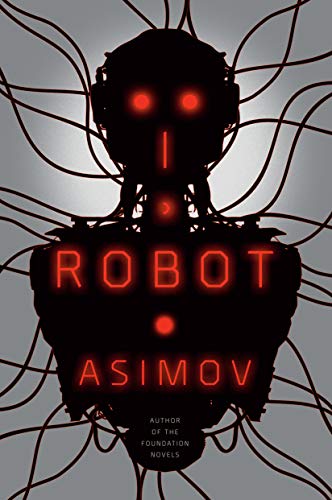
Ebook Info
- Published: 2004
- Number of pages: 304 pages
- Format: EPUB
- File Size: 0.19 MB
- Authors: Isaac Asimov
Description
This classic science fiction masterwork by Isaac Asimov weaves stories about robots, humanity, and the deep questions of existence into a novel of shocking intelligence and heart. “A must-read for science-fiction buffs and literature enjoyers alike.”—The Guardian I, Robot, the first and most widely read book in Asimov’s Robot series, forever changed the world’s perception of artificial intelligence. Here are stories of robots gone mad, of mind-reading robots, and robots with a sense of humor. Of robot politicians, and robots who secretly run the world—all told with the dramatic blend of science fact and science fiction that has become Asimov’s trademark. The Three Laws of Robotics: 1) A robot may not injure a human being or, through inaction, allow a human being to come to harm. 2) A robot must obey orders given to it by human beings except where such orders would conflict with the First Law. 3) A robot must protect its own existence as long as such protection does not conflict with the First or Second Law. With these three, simple directives, Isaac Asimov formulated the laws governing robots’ behavior. In I, Robot, Asimov chronicles the development of the robot from its primitive origins in the present to its ultimate perfection in the not-so-distant future—a future in which humanity itself may be rendered obsolete. “Tremendously exciting and entertaining . . . Asimov dramatizes an interesting question: How can we live with machines that, generation by generation, grow more intelligent than their creators and not eventually clash with our own invention?”—The Chicago Tribune
User’s Reviews
Reviews from Amazon users which were colected at the time this book was published on the website:
⭐I, Robot(1950)I, Robot contains the following:IntroductionRobbieRunaroundReasonCatch That RabbitLiar!Little Lost RobotEscape!EvidenceThe Evitable ConflictIt is amazing to me the science fiction writers who”cut their teeth”, so to speak on Asimov. Just read the Introduction/Preface”I, Robot” For me, reading Asimov is a good starting point to reading Science Fiction. Oh, you could read Norton’s Juveniles or Heinlein, but, you can’t go wrong with the “Good Doctor” either.BTW, don’t think that if you’ve seen
⭐the movie that you can skip the book. The movie has very little to do with the book. They both had the same title and they both dealt with robots or androids, but that’s it.If you have never read Asimov or looking for somewhere to start, I would highly recommend “I, Robot” as a first glimpse into Asimov’s world(s). Here is a wonderful and timeless collection of nine short stories that all center around a central theme; The Three Laws Of Robotics.The three laws are: 1) A robot may not injure a human being or through inaction allow a human being to come to harm. 2) A robot must obey orders given it by human beings except where such orders would conflict with the First Law. 3) A robot must protect its own existence as long as such protection does not conflict with the First or Second Law.These laws are the central theme to each individual story, and connecting them is a running theme “Runaround”, “Reason”, and “Catch That Rabbit”. Always under the direst of circumstances, they must figure out the malfunction of the robot before something terrible happens. Very entertaining stories.Some of the other stories are about Dr. Calvin’s personal experiences, such as “Liar” and “Little Lost Robot”, but all fall back onto the laws as their basic theme, and whether or not humans will ever accept robots among them.Once finished with “I, Robot”, I very highly recommend the “Foundation” series, one of my favorite Asimov themes, along with the Robot Trilogy and another favorite, “Nightfall”. Asimov has the gift of creating lively, likeable characters with a technical backdrop to his all-to-human stories, and always infuses a bit of humor into them.Truly one of the great masters of Sci-Fi, Asimov is a must-read in my opinion, and “I, Robot” is a wonderful starting point.Enjoy!”I, Robot” is the classic science fiction novel by Isaac Asimov. It kicks off the best selling Robot/Foundation series, though when “I, Robot” was first published it was not intended to be a part of any larger series, nor were Robot and Foundation originally connected. While the format of “I, Robot” is loosely a novel, it is truly a collection of short stories that is bridged by a common thread and text that connects all stories together.The tie that connects these stories together is Susan Calvin, a robopsychologist. At the start of the book, Calvin is retiring from her position at U.S. Robotics. A reporter is trying to get her thoughts on the history of robotics, but not the official position, more of her personal impressions. Calvin was at U.S. Robotics when the first truly “thinking” robots were released for sale and was at the forefront of figuring out why some robots were acting the way they were. The format of “I, Robot” is such that Calvin is essentially giving a little bit of background which moves into the short story, giving an episodic feel to the book.As the stories move in chronological order, the reader is presented with the evolution of robots, starting with “Robbie”, which deals with the relationship a little girl has with her robot, Robbie. Robbie was designed as a playmate for a little girl and her parents feel that she has become too attached to the robot and has forsaken real friends. Robbie is an earlier design robot: large, clunky, and without the ability to speak. The subsequent stories show the development of robots and include: a mind reading robot, a robot who does not believe it is possible that a human could create a robot, and one that may even end up ruling the world.Through these stories, Asimov has set up the Three Laws of Robotics, which are:1 – A robot may not injure a human being, or, through inaction, allow a human being to come to harm.2 – A robot must obey the orders given it by human beings except where such orders would conflict with the First Law.3 – A robot must protect its own existence as long as such protection does not conflict with the First or Second Law.These Three Laws are the driving force within each of the stories. What is interesting here is that all of the stories are something of a “whodunit”. Something is not working exactly right with a robot and it is up to Susan Calvin, or the team of Martin and Donovan to figure out why a robot is not working how it is expected to. Each time, it has something to do with the Three Laws and everything makes sense within the confines of the Three Laws: Calvin, Martin, and Donovan just have to figure out what.The writing style here is simple, and easy to read. Despite the fact that there is little “action” happening in the stories, they move along quickly. These are stories of humanity and science and the robots seem to fit into both categories at the same time. “I, Robot” is rightly considered a classic of science fiction and these are simple little gems with a depth of complexity that makes everything fit together.I highly recommend this as a starting point for Asimov, and Science Fiction, for that matter.Asimov was a true visionary.If you’re looking for an indepth review of how Asinov would put together his short stories go to http://www.amazon.com/review/RPDE80CI9AUW8/ref=cm_srch_res_rtr_alt_1Gunner May, 2010
⭐I did like it, and one of the reaccuring character’s way of picking out how robots are made to think, thus solving specific robotic problems.I enjoyed seeing how Asimov worked out the three laws of Robotics, but some of it got a bit too technical and political. Those parts I tended to skim.
⭐I can’t believe I waited until I was in my 40s to read this book! I realize now how much it has influenced all the sci-fi that came after it! I would highly recommend this book to anyone interested in science fiction or even just robots/androids! It’s a fascinating read from a psychological/sociological view as well!
⭐I liked the multiple narratives in the book. However, I feel there was a rush in some parts, where maybe the author could have provided more detail similar to the rest of his bibliography.
⭐I, Robot is a sci fi classic of collected short stories by Asimov — published in 1950. Interesting to see what Asimov, a prof of chemistry, was able to predict and not predict about the world 70 years down the road. What is clever in the book is how a robot psychologist is able to get into the mind of robots and even out smart them. You can also find some precursors of Star Trek and Star Wars in the stories (e.g. hyperspace). No aliens or ETs however. A fun quick read.
⭐I, Robot is a great book to read and I would recommend it to everyone. Asimov used the cultural trend of futuristic science and the fear of what could happen extremely well. Through each story humanity was faced with a new challenge and fear. Robots in the book were becoming more and more like humans. In the way of developing personalities and eventually realizing that they are superior. This is the biggest fear of robotics then and even now.I personally enjoyed reading I, Robot. Reading about the types of fear that people had during Asimov’s time and its relevance now makes the book more personal. The constant struggle between technology and humans is an everyday challenge for us now and Asimov depicts our lives now almost to a “T”. The point of complete independence for robots is in the not too far future for us, especially with the develop of super computers like Watson and Amazon’s household aid Alexa.The book from an academic standpoint is phenomenal. Asimov uses the fear from his current day and the use of what could possibly happen and turns it into a very real situation. The book works as a conglomerate, keeping each story distinctive, but working as a whole to the conclusion. The stories add to each other to show the development of technology over time. All of the developments lead to the last story and the struggle of humans losing control of themselves. I would have liked to have known more details about how each development of robots affected the world around it and the consequences or benefits from these developments through out time.
⭐I first read this book around the age of 11 or 12. At the time, while acknowledging the future it promised was unlikely to elapse in the timeframes of the book, it fascinated me that the possibilities were there.It’s hard to argue that an AGI would not consider itself superior to humans, and the creation of the three laws of robotics and the implications, the warnings, implicit in this book for mankind make it something anyone embarking on a career in ML/AI should read as a required text.
⭐If you’ve an interest in SciFi or AI you should have heard of the 3 laws of robotics. This is the source of those rules the explanation of what they are and the consequences of messing with them. Not the book I remember from school, but that could have been an anthology of all Asimov’s robot books as several others are listed in the series that ring bells as just chapters of the book I recall. It makes the point that because of the 3 laws you can’t tell a robot from a good human, my interpretation is you don’t need 10 commandments just the 3 laws
⭐Data, C3PO, Bishop et Al, say thank you to the creator. Okay, some of the lifestyle predictions have dated (this waswritten in the 50s) but the humanist core of the stories are as fresh as ever.HIGHLY recommended, if you like Sci-Fi, this is essential reading.
⭐This is a thought provoking book, about robots and humanity. It is a series of short stories that all focus on Asimov’s three laws of robotics.The stories are well written, interesting and thought provoking. Having said that, I found them slightly repetitive and sometimes narrow in scope, hence the three stars.It was worth me reading it but it’s not necessarily a classic or masterwork in my mind.
⭐My very first Isaac assimov book. I picked this one cos I have seen the film and yes I know they aren’t exactly the same but I didn’t expect them to be.Loved it and will definitely read more .
Keywords
Free Download I, Robot (The Robot Series) in EPUB format
I, Robot (The Robot Series) EPUB Free Download
Download I, Robot (The Robot Series) 2004 EPUB Free
I, Robot (The Robot Series) 2004 EPUB Free Download
Download I, Robot (The Robot Series) EPUB
Free Download Ebook I, Robot (The Robot Series)