Ebook Info
- Published: 2007
- Number of pages: 254 pages
- Format: PDF
- File Size: 1.90 MB
- Authors: Alex Rosenberg
Description
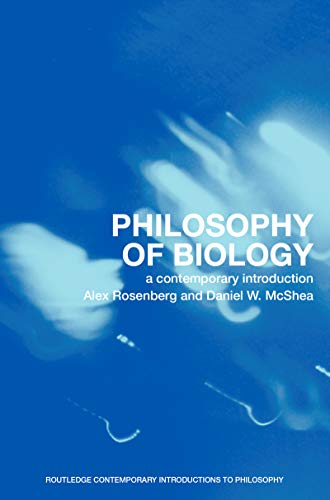
Is life a purely physical process? What is human nature? Which of our traits is essential to us? In this volume, Daniel McShea and Alex Rosenberg – a biologist and a philosopher, respectively – join forces to create a new gateway to the philosophy of biology; making the major issues accessible and relevant to biologists and philosophers alike.Exploring concepts such as supervenience; the controversies about genocentrism and genetic determinism; and the debate about major transitions central to contemporary thinking about macroevolution; the authors lay out the broad terms in which we should assess the impact of biology on human capacities, social institutions and ethical values.
User’s Reviews
Reviews from Amazon users which were colected at the time this book was published on the website:
⭐Rosenberg is a master when it comes to writing interesting textbooks and this is no different. From start to finish, this book is an excellent, up-to-date discussion of the most pertinent issues in the philosophy of biology (laws, explanation, teleology, reductionism, group selection, etc…). By the end of this book, you should be better prepared to converse and read about more specific issues in the field.
⭐This is a masterpiece in the field.
⭐Hard terminology
⭐There have been several books carrying the ostensibly vague, if not pompous, title of “Philosophy of Biology” (see the two edited by Hull and Ruse, one for Oxford and the other for Cambridge University Press; and one by Ruse for Prometheus). Most of the others are compilations of essays written by diverse writers. One will find Rosenberg and McShea refreshingly original. It is profound and yet lucid. It stated its aims clearly, explaining from the outset the meaning of the phrase “The Philosophy of Biology” as an inquiry into the science of biology, not limited to what it actually does as a science, or its methods as such, but to scrutinise its scope and limits. A study of this kind will necessarily inquire into the possibilities and potential of this science, and questions its strength and the challenges that it faces, notably from religious quarters seeking to damn it as quixotic in so far as they think that some questions of life are impenetrable to science; and others who think that they can masquerade religion as science.The thrust of the book lies in its explanation of “Darwinism”, especially as to what it means scientifically, and what it has achieved or proven and what its problems are. It seems clear from this book that the problems of Darwinism are problems of science. However, many questions arise which have cross-disciplinary interests. The role and extent of adaptation in the evolution of living things is a fertile field. Why do distinct species evolve with common traits and what cause the development of those traits? How do we evaluate the effect of randomness in evolution?2009 marks the 200th anniversary of Darwin’s birth and 150th anniversary of the publication of “The Origin of Species”. It may be worthwhile to read the latter again after reading Rosenberg to see just how far we have come since Darwin, and why we owe so much to its author. Darwinism casts such an awesome shadow that underneath it, the flower of Creationism can no longer bloom. Creationism, “intelligent” design and various unscientific intrusions into science have tended to distract scientists and philosophers from their work. Rosenberg and McShea also felt obliged to answer some of the claims of Behe when they could have concentrated on the impartial examination of life, free from the vanity that humans are central to the universe.This book is not difficult even for people who have no knowledge of biology, philosophy, or Darwinism.
⭐As far as science writing goes, this stuff is unreadable. Pedantic, verbose, and scattered. Any point which can be easily made is spread out over pages and huge pointless paragraphs. I rarely see such horribly organized thoughts. It is written as if a college professor is trying to teach a 9 year old the philosophy of biology. Painful to read.
⭐C’est une très bonne introduction aux divers thèmes qui animent la philosophie de la biologie.Je la recommande pour ceux que l’anglais ne rebute pas.
⭐
Keywords
Free Download Philosophy of Biology: A Contemporary Introduction (Routledge Contemporary Introductions to Philosophy) 1st Edition in PDF format
Philosophy of Biology: A Contemporary Introduction (Routledge Contemporary Introductions to Philosophy) 1st Edition PDF Free Download
Download Philosophy of Biology: A Contemporary Introduction (Routledge Contemporary Introductions to Philosophy) 1st Edition 2007 PDF Free
Philosophy of Biology: A Contemporary Introduction (Routledge Contemporary Introductions to Philosophy) 1st Edition 2007 PDF Free Download
Download Philosophy of Biology: A Contemporary Introduction (Routledge Contemporary Introductions to Philosophy) 1st Edition PDF
Free Download Ebook Philosophy of Biology: A Contemporary Introduction (Routledge Contemporary Introductions to Philosophy) 1st Edition