Ebook Info
- Published:
- Number of pages:
- Format: PDF
- File Size: 1.82 MB
- Authors: Alex Rosenberg
Description
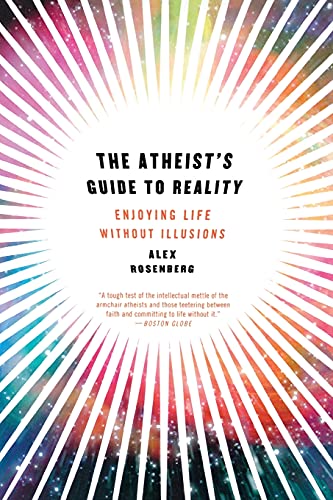
“A tough test of the intellectual mettle of the armchair atheists and those teetering between faith and committing to life without it.”―Boston Globe We can’t avoid the persistent questions about the meaning of life―and the nature of reality. But science is the only means of answering them. So declares philosopher Alex Rosenberg in this bracing, surprisingly sanguine take on a world without god. The science that makes us nonbelievers, he demonstrates, tells us the nature of reality, the purpose of everything, the difference between right and wrong, how the mind works, even the direction of human history. 8 illustrations
User’s Reviews
Reviews from Amazon users which were colected at the time this book was published on the website:
⭐Full disclosure: I am an atheist; I don’t believe in the supernatural; science is my guide to reality; and I believe morals are a biological/cultural phenomenon with no ultimate justification. Given all that, you’d think Rosenberg and I would have a lot in common, and we do, but he is stuck in an extreme version of the idea that “physics fixes all the facts,” (Kindle Locations 3859-3860) which leads him to some shaky and valueless conclusions.Most of the book hinges on the idea that our thoughts are not “about” anything. On that basis Rosenberg concludes that we don’t have purposes; that we don’t think about the past or make plans for the future. (Location 2704) He admits that these claims are outrageous, recognizes the need for compelling arguments if we’re to be convinced of them, and spends three chapters trying to make his case, starting with this example:”Suppose someone asks you, “What is the capital of France?” Into consciousness comes the thought that Paris is the capital of France. Consciousness tells you in no uncertain terms what the content of your thought is, what your thought is about. It’s about the statement that Paris is the capital of France.” (Locations 2809-2811)”It’s this last notion that introspection conveys that science has to deny. Thinking about things can’t happen at all. The brain can’t have thoughts about Paris, or about France, or about capitals, or about anything else for that matter. When consciousness convinces you that you, or your mind, or your brain has thoughts about things, it is wrong.”(Locations 2816-2818)He goes on to propose that if we know that Paris is the capital of France, then there must be neurons in our brains that encode that information. They must be “about” Paris in the same way that a stop sign is “about” stopping. Then he suggests that there is a difference between these two instances of “aboutness.””If the Paris neurons are about Paris the same way a red octagon is about stopping, then there has to be something in the brain that interprets the Paris neurons as being about Paris. After all, that’s how the stop sign is about stopping. It gets interpreted by us in a certain way. The difference is that in the case of the Paris neurons, the interpreter can only be another part of the brain.” (Location 2880)Since “interpretation” has the power to grant “aboutness,” you’d think it would be a topic that merits discussion. Rosenberg mentions it later in talking about our ability to interpret pixels on a computer monitor, but with no explanation of how it might work:”They get interpreted by us as letters spelling English words. That’s how they come to be about the things that the pixels are about. So, no aboutness anywhere in the computer without interpretation by us–by our mind, our brain.” (Location 3051)But how do “we,” or our brains, “interpret” the stop sign, or the pixels? The light from either of them is focused onto the retina, where it stimulates neurons to send signals to the brain. From the retina onward, both stop sign and pixels are encoded in neural connections, and in that sense are no different from information about Paris. If there are Paris neurons, there must be stop sign and pixel neurons, and all have to be interpreted by the same brain. How could Rosenberg have an insurmountable problem with the Paris neurons being about Paris, but not have a problem with stop sign neurons being about stopping, or pixel neurons being about words. It seems likely that he has not thought seriously about what it means when he says, “we interpret,” or if he has, he’s hoping that the reader won’t think about it.Rosenberg theorizes that in order for the Paris neurons to be “about” Paris, there has to be a set of interpreter neurons that are both “about” Paris, and “..that `say’ that the Paris neurons are about Paris…” (Location 2905) setting up an infinite regress:”We set out to explain how one set of neurons is about something out there in the world. We find ourselves adopting the theory that it’s because another set of neurons is about the first bunch of neurons and about the thing in the world, too. This won’t do.” (Locations 2911-2913)From this, Rosenberg concludes that the only way to avoid the regress is to conclude that the Paris neurons can’t be “about” Paris. What we have to realize is that he has stacked the deck. He says that the only way the Paris neurons can be about Paris is if they are “interpreted” as being about Paris, and then proposes a set of impossible conditions that the interpreter would have to meet:”What we need is a clump of matter, in this case the Paris neurons, that by the very arrangement of its synapses points at, indicates, singles out, picks out, identifies (and here we just start piling up more and more synonyms for “being about”) another clump of matter outside the brain. But there is no such physical stuff. Physics has ruled out the existence of clumps of matter of the required sort. There are just fermions and bosons and combinations of them. None of that stuff is just, *all by itself,* about any other stuff.” (Location 2915, emphasis added)He glosses over the fact that the clump of matter in question is not “all by itself.” The Paris neurons are connected to other neurons which, in conjunction with them, are capable of generating behavior that can be interpreted as being “about” Paris. That is what interpretation *is*–our brains take information that is encoded in neurons that don’t look anything like the information they’re encoding, and translate it into another format that looks like, or sounds like, English, or whatever language we speak.Having made the point, at least to his own satisfaction, that thoughts cannot be about things, he goes on to state that, nonetheless, “…no one denies that the brain receives, stores, and transmits information.” (Location 2819) “The brain nonconsciously stores information in thoughts.” (Location 2922) “…we think accurately and act intelligently in the world.” (Location 2708)Rosenberg has no problem granting that our brains have these abilities and yet these very abilities contradict his denial that thoughts can be “about” things. Information is *inherently* “about” things, and although the neurons that encode it may not recognizably be about anything, they have to be capable of generating behavior–writing or drawing, for example–that *is* about something, that is recognizable by others as being about something, or else no information can be transmitted. The fact that we think “accurately” means that our thinking has to be “about” something verifiable by others, otherwise how can its accuracy be judged? Likewise, how can we know that we’re acting “intelligently” unless we’re moving toward an apparent goal in an efficient, “intelligent” way?Part of Rosenberg’s problem is his misconception of consciousness:”The brain nonconsciously stores information in thoughts. But the thoughts are not about stuff. Therefore, consciousness cannot retrieve thoughts about stuff. There are none to retrieve. So it can’t have thoughts about stuff either.” (Location 2922)The misconception here is that consciousness is some kind of brain mechanism that can “retrieve” thoughts, and “have” thoughts. He seems to be referring to some similar function for consciousness in this passage: “Introspection must be wrong when it credits consciousness with thoughts about birthdays, keys, and bosses’ names.” (Location 2783) That introspection “credits” consciousness would indicate, again, that consciousness is some kind of mechanism that “retrieves” stuff.It seems more likely that those things that appear in consciousness are things that *have been* retrieved and translated by unconscious neural processes into things that are communicable, either in terms of language or images. For most of us, most of the time, we are conscious of that which we overtly communicate. People who talk in their sleep, or are under the influence of certain drugs or hypnosis, may communicate without being conscious of doing so, and all of us may frequently communicate things through facial expressions or body language of which we are not conscious, but usually, if we are talking, writing, or drawing pictures, we are conscious of what we’re intending to communicate.Rosenberg seems to be trying to counter the naive intuition that we are somehow in conscious control of our thinking–that we have free will–but there is a much more convincing and less convoluted way to make that point. If you search YouTube for “Sam Harris free will,” you will be treated to an entertaining demonstration of how this can be done without positing the nonsensical idea that our thoughts are not about anything.It’s true that we are not in control of our thoughts–the processes by which our brains produce them are not available to consciousness–but we *do* have them, and they are “about” things. None of the accomplishments of civilization would be possible if people were incapable of having and communicating thoughts about “clumps of matter.”Rosenberg says,”Our conscious thoughts are very crude indicators of what is going on in our brain. We fool ourselves into treating these conscious markers as thoughts about what we want and about how to achieve it, about plans and purposes. We are even tricked into thinking they somehow bring about behavior. We are mistaken about all of these things… Whatever neural arrangements these conscious markers consist of, they are almost certainly not sufficient in number or organization *by themselves* to drive the behavior that is supposed to result from conscious thoughts about stuff.” (Locations 3407-3412, emphasis added.)It’s true that conscious thoughts are only the tip of the iceberg of brain activity, and that “by themselves” they don’t drive behavior, but they are, in fact, *never* “by themselves”–they don’t occur in a vacuum. Anyone can have the conscious thought, “I could be President of the United States,” but that thought has to be accompanied by abilities, and those abilities have to be exercised, and one has to have good luck, if that desire is to be realized. At the same time, if you had never had the conscious thought that you might become President, it’s unlikely you would ever achieve that position. Bridges and buildings would never have been built if someone had not *at least* had the thought that they could build them, and if they had not been able to communicate *plans* about how construction was to proceed.Certainly, language is inadequate to describe most of what goes on in our brains, but that doesn’t mean that our thoughts are not about stuff, or that they’re useless in communicating and learning about stuff. A lot depends on the subject matter. If you ask someone why they became a professor of philosophy, you may expect that their answer won’t come close to an accurate description of that decision’s roots. On the other hand, if you ask someone from France what its capital is, you can be fairly sure of getting the right answer, and you can always check Wikipedia to confirm.Rosenberg’s pronouncements throughout the book, but especially toward the end–on history, art and literary criticism, psychotherapy, etc.–would be pointless if thoughts were not about things. Instead, he takes “aboutness” for granted and argues whether such human pursuits are *accurately* or *intelligently* about things.The subtitle of this book is “Enjoying Life Without Illusions,” but I think few will find much that’s helpful in that regard. Rosenberg hasn’t convincingly argued that our thoughts are illusions, and since they’re not illusions, anything he might offer for enjoying life without them would be beside the point. If they *were* illusions, and not really about anything, it would seem to preclude his offering thoughts that might reveal the brighter side of our situation.There is a brighter side. Statements about the human condition can alter our perception of the human condition in ways that lead toward greater happiness and enjoyment of life. You won’t find many such statements in this book, but they are available. Thomas W. Clark’s book, Encountering Naturalism, is a good place to start.One illusion that Rosenberg is right about is that we don’t have free will, and it is certainly possible to be happier without that illusion than with it. I’ve been working on it for a couple of decades with considerable success, at least for me, and sharing what I’ve learned through my blog, “The Short Version.” Here’s a good post to start with if you’re interested: […]
⭐IntroductionGod does not exist. Physics is the only reality. There is no purpose in life. If these statements are true, why try our hand in life? In The Atheist Guide to Reality: Enjoying Life without Illusions, Alex Rosenberg uses science to argue that most people live under the illusion of meaning, purpose, and a sense of self-being that prevents them from grasping an atheistic worldview–free from abstractions and useless warm feelings. With a conviction to find reality through the facts of science and physics, this book seeks to answer life’s persistent questions and reasons through many of the illusions people live with.SummaryIn chapter one, Rosenberg lays down two foundational arguments to understanding his book. First, the word atheism is not an adequate description of what atheists hold because it only focuses on what they do not believe, as opposed to what they do believe. Claiming that many people wrongly label atheists as immoral people, Rosenberg proposes a new term which he hopes will rightly emphasize their worldview: scientism (6). Second, he contends that the innate desire for people to hear stories will prevent them from embracing scientism; science does not come in stories. To live the unbridled life of scientism, he argues that we must give up our stories and embrace the cold hard facts of science (7). In chapter two, he argues that the only means by which to ascertain the nature of reality is through the established school of physics (20). He argues that the most basic and smallest makeup of the cosmos is matter; there is no other means by which to dissect and analyze the existence of our cosmos. He then introduces the second law of thermodynamics as the key to understanding the nature of physics. The second law chiefly states that the energy levels within any expanse will very likely distribute evenly in their energy, temperature, and disorder (29). Thus, the explosion of the big bang resulted in the expansion of matter–thus creating the universe. He concludes that the improbability (and almost impossible chance) of such an explosion proves that there can be no meaning the universe (35). Any meaning or story we attach cannot be supported by physical facts. In chapters three and four, Rosenberg shifts the camera from the cosmos and zooms into Mother Nature’s adaptation of molecules and biology. He admits that much of biology gives the appearance of a higher purpose or design, but argues that this is only an illusion of the highly adaptive and wasteful nature of the universe (57,73). When the highly disorganized mixture of matter began billions of years ago, the countless number of molecules bouncing around the cosmos eventually attached or separated from one another to create life (69). Finally, he concludes that the highly wasteful nature of the “natural selection at the molecular level” underlines a lack of purpose (70,73). In chapters five and six, he takes his reader through the implications his argument has for morality. Taking the subject at face value, he reasons with his reader to realize that a cosmos with no meaning or purpose must be unapologetically nihilistic. Since there is no God, standard for morality, or purpose behind the cosmos, those who embrace scientism must realize that it is impossible to classify anything as morally right or wrong (113). Yet, Rosenberg does offer a glimmer of hope within this nihilism by labeling our innate core morality as “nice nihilism” (102, 144). In chapters seven through ten, Rosenberg advocates that science denies the concept of introspection and conscious thought, thereby underscoring that there is no “existence of selves, souls, persons, or nonphysical minds inhabiting our bodies” (220). He articulates three experiments to state that introspection, free will, and vision are inaccurate means by which to understand our minds. The first experiment supports that introspection cannot be trusted because everyone has the ability to experience blindsight (the ability to subconsciously view something without experiencing the act of seeing the stimuli) (151). His second experiment supports that we do not have free will because we move our body parts milliseconds before willing them to move (152). His third experiment supports that our vision cannot be trusted because we all experience optical illusions (156). From these three experiments, he concludes that how our minds work is radically different from what we assume (193). Thus, we cannot consciously have thoughts and ideas about things because, he argues, our mind is merely a physical organ that works similarly to a computer (188). Thoughts, beliefs, emotions, and ideas are only illusions of the mind (148). In chapter eleven, the author deals with the implications scientism has with history. He argues that history is irrelevant because the age of human history is incongruent with the length of cosmic history that surpasses billions of years (249). He also argues that human sciences are insignificant since the world is constantly being transformed by the endless arms races of competing people groups (263). In short, human affairs are so interwoven with “blind variation and environmental filtration” that whatever data gathered from history will be outdated, useless information to other adapting generations (251). Finally, in chapter twelve, the author culminates all of his arguments from the preceding chapters to draw out scientism’s implications on optimism, morality, and politics. First, he argues that there is no need to soften scientism to have a happier outlook or create a sense of value in one’s life. Those who feel a particular urge to embrace religion or secular humanism cannot deny that their aims are unattainable (277). Second, scientism liberates us from the bind of heated moral arguments and the justice system because nothing or anyone can be deemed morally right or wrong (287). Finally, he argues that scientism implies a radical view on politics. Since free will does not exist, the unequal distribution of wealth and the punishment of crime are unfair (293).Critical EvaluationToday’s Christian will be utterly hindered by his incapacity to defend the faith if he cannot understand the philosophical and scientific arguments from the naturalist worldview. If read with an analytical and discerning mind, The Atheist Guide to Reality: Enjoying Life without Illusions can be an exceedingly useful tool for the Christian theist to understand his secular contemporaries. Using scientific research and uncanny wit, Alex Rosenberg offers a hard case in answering life’s persistent questions. They unapologetically defy the Christian theist’s worldview. Though Rosenberg offers an intellectually stimulating and dynamic approach to his scientific worldview, his arguments lack the ability to prove his answers to the persistent questions. The scientific data he puts forth may be compelling at face value–but none of it has the weight to conclude that matter exists exclusively and, consequently, the spiritual realm does not. At best, his arguments can only be determined as reasonable theories. To give one example: in trying to prove that the history of the cosmos began with a random chance of events, he begins by listing facts such as cosmic background radiation and the expansion of matter. But when his own argument urges him to explain the first cause of the big bang, he injects the following statement near the end of the second chapter: “With an indefinitely large number of different universes being created all the time, some of them will just happen to have the mix of things and forces that brings us about” (43). It is not hard to see the speculation and wishful thinking behind such a statement. After trying to prove his point at some length (twenty four pages to be exact), he fails to prove his argument. He fails to prove the first cause of the multiverse. His physics do not fix his facts. Rosenberg lacks academic honesty with his adversaries. In the beginning of his book, Rosenberg stated his two, all-encompassing presuppositions: the spiritual realm does not exist and physics can prove it (3). Any scholar will appreciate this honesty. Yet he does not maintain the same integrity with other worldviews throughout his book. When he goes out of his way to misrepresent theism or make underhanded remarks, his academic respect declines and he discredits his own thesis. Rosenberg contradicts himself by adding optimism to his inferences. In regards to the implications scientism holds, he contends that his conclusions are nihilistic. If this is so, why does he desperately fight to add value and purpose in his last chapter? By saying that human beings were adapted by Mother Nature to survive, he adds purpose to life (280). By insisting atheists to swing their political views toward a redistributionist society, he inherently adds value to society (298). By saying “there is nothing that makes life worth living” and then stating that suicide is never the answer, he makes a moral argument (281). Rosenberg may claim that his conclusions are nihilistic but his own statements discredit his point–purpose, value, and morality are not nihilistic. To use his own line of reason: his pinch of optimism is not backed by physics and they do not fix the facts. Finally, it is important to note that a large chunk of his book is devoted to deconstructing the basis for a sense of self, will, or conscience but yet he uses statements such as the following after his arguments: “I am going to get scientism into your skull” (193). “I know this sounds absurd” (162). “If this seems hard to take… there’s always Prozac” (19). “There isn’t any rhyme or reason to the universe. It’s just one damn thing after the other” (92). “We have to accept it” (112). If his conclusions are as undeniable and concrete as he claims they are, there would be no need to pepper his book with such confrontational statements.ConclusionThe Atheist Guide to Reality: Enjoying Life without Illusions by Alex Rosenberg seeks to solve problems but instead creates them. Scientism has no sympathy or understanding for people in pain, hurt, and suffering. It does not adequately explain the origin of the universe or why beings can have the ability to think or reason. It does not differentiate the act of suicide with getting up in the morning. Worse, it is an ultimate rejection of what we are and who we were made for. Rosenberg emphatically argues that he can answer the consistent questions with scientific facts. Yet, terms like natural adaptation, environmental filtration, chance, and Mother Nature are not adequate to do so. His science has many holes–they cannot prove his conclusions. Therefore, the only thing his arguments can really do is yell loudly and flap its arms around. If his worldview could be lived out, one must wonder how long the world would last.
⭐First off, in case Alex is actually reading through some of these reviews in a morose attempt to find some verification (i’m sure he has better things to do with his time) I think think this book has some VERY good ideas behind it and that Alex really does have a good grasp on this issue if you read some of his other works.Unfortunately despite the boldness of the opening, proclaiming a profoundly concrete answer to some of the supposed big questions of life, the lack of proper editing and an ambling prose leads the actually points that he’s trying to make into a total mess by the end unless you’re already convinced by most of the points Alex is making.The notions about what physics is, how it relates to determinism and free will are par for the course. The analogies used to explain how some of the “theory of mind” critics have been barking up the wrong tree are well explained but poorly explored. I think if more pages were dedicated to these I think there would be more grounds to side with his attmepts dismiss the ideas about conciousness further on in the book.The biological explanations of how we as humans interact both politically and psychologically are again well written but the problems begin with how the actual content of the book is written and it’s style.Alex has a few bad habits, and they are REALLY bad. In his attempt to reclaim “scientism” as a positive word over a perjorative as cynics of science have started to use it he’s been reduced to use the damn word about 10 times on every page as if repeating it enough times will convince you it’s true, or maybe he’s just trying to jam it into our lexicon so we inadvertently pick it up.Also the way he tries to run you through some of arguments for his claims is just tedious. Endless analogies and explanations are repeated some 3 times over in just a few pages, as if he’s just trying to make up the word count set by his publisher. This book could really have done with a few more re-drafts with help from a proper editor… and a thesaurus.What’s worse is that Rosenberg has written some REALLY great books that are marvellously written and on par with the explanatory power of books like Dawkin’s “The blind watchmaker”. So it’s inexcusable that such a book that’s intended to popularise the positive notion that athiesm isn’t some evil boogey man of science, ends up forcing you to scratch you head at every step to find what Alex’s actual arguments are trying to get at.I think maybe the problem lies with trying to explain the illusion of intentionality without appealing to the language of it that we’re so used to. But other philosopher’s such as Dennett have a natural talent for doing that.Rosenburg’s position isn’t an intuitive one, and it’s certainly not a well popluarised one amongst a lot of atheist’s so this book really needed to nail the introduction to the argument he’s proposing about removing the “aboutness” of conciousness from our worldview. It needed clear examples, step by step argumentation with clear premises leading to a distinct conclusion… and it just… really doesn’t work.And it works even less when you get to his views on history. So he appeals to the pragmatics of the physcial sciences. Then procedes to state that nothing can be said about history or politics or economics except through a lens of physical reductionism. A rather black or white position compared to the previous pragmatic one.Well that’s all great and all until you realise that computationally you simply cannot do that, even with the biggest Deep Think PC ever concieved off. The argument comes across as equivocating because he’s using an ever increasing accuracy of physics derived from innaccurate common sense psychology to backup his argument that physicalism is the final answer. I agree it’s the final answer ontologically, but saying there is an impossible divide of the humanities, even if they use a scientific method to establish truth about the world is just flat out wrong. If you just want a pragmatic answer then you’re not going to be looking for a completely reducible account of why “Henry VIII killed his wives” in terms of physical laws. You’re just looking for an explanation that falls into the purvue of psychology. It doesn’t matter if it falls down to neurons firing in this order or that because if you can’t ACTUALLY calculate that (which unless every person is walking around with a portable MRI scanner) then you simply can’t do ANY science on the matter.Again, this might be a strawman, but given the lack of clarification, poorly written statements with no real coherent premises you’d be hard pressed to interpret it any differently. Using ever more accurate terms for representing the mind in a physical manner brings you closer to the “true” answer, but it doesn’t make it pragmatically feasible to demand a neuron level account of human thought every time. I don’t think any neuroscientist when pressed would want to commit to that anymore than a software engineer would demand we all code everything in assembly logic.His most important sections, the ones on conciousness itself are unfortunately the most muddled, and given it’s trying to talk about how unreliable introspection can be, you would have thought maximising one’s ability to introspect correctly on the matter whilst reading would have been a priority, either with well thought out verbage combined with good examples of empirical data (not just piece-meal appeals to blindsight experiments).Anyway, moral nihilism ‘good’, explanations of biology fantastic, political ideology of humanity still pretty great, but his views on historcism are just…. cringe.Go find a copy of his book written with McShea on the Philosophy of Biology. It far surpases this one in everyway.Perhaps this is a lesson in the trials of publication deadlines. I don’t know. I can only comment on the content as it stands… and Alex would lambast me for daring to infer that I can examine his intentions without appealing to the phsyical facts ;)Tl;dr Lacked a clear direction and just got lazy at the end of the book in order to meet a word count.Really dissapointed given Rosenburg is hardly known for his inability to write well or his oratory skills in lectures. Side effects of taking too much prozac I guess.
⭐Great book, well worth reading. However… his claims about meaning are ultimately self-refuting. He’s aware of this problem, but he has yet to provide a solution.The chapters on ethics are great.
⭐This is the book I was ready to read. Belief in Santa Claus is as plausible as belief in God. But the science,I was convinced, however cold and calculated, is our only irrefutable reality. This book has piqued my interest in a fascinating way of looking at the world.I understood little of the science which was exposed at length but still I couldn’t put it down. If you have a strong faith don’t bother but if you are atheist, be proud. As Rosenberg said, we atheists will still find a reason to get up of a morning!
⭐A thorough working out of the implications of “physical facts fix all the facts”. It may make you uncomfortable, and you may not like it much, but if you’re committed to following the facts, then this is a journey you need to undertake.
⭐At last,someone other than a big name scientist or evolutionary biologist(dont get me wrong,I have the greatest respect and admiration for Dawkins,Hitchins,Dennett,et al) has come out with the way it really is. Good on you,Alex.
Keywords
Free Download The Atheist’s Guide to Reality: Enjoying Life without Illusions in PDF format
The Atheist’s Guide to Reality: Enjoying Life without Illusions PDF Free Download
Download The Atheist’s Guide to Reality: Enjoying Life without Illusions PDF Free
The Atheist’s Guide to Reality: Enjoying Life without Illusions PDF Free Download
Download The Atheist’s Guide to Reality: Enjoying Life without Illusions PDF
Free Download Ebook The Atheist’s Guide to Reality: Enjoying Life without Illusions