Ebook Info
- Published: 2011
- Number of pages: 321 pages
- Format: PDF
- File Size: 1.40 MB
- Authors: Alex Rosenberg
Description
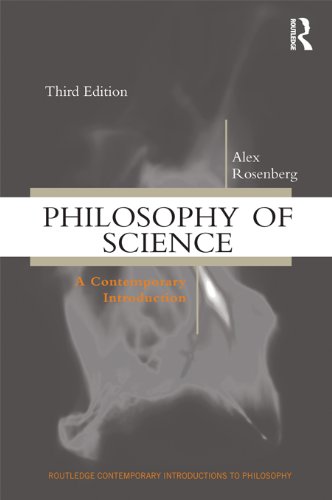
Any serious student attempting to better understand the nature, methods and justification of science will value Alex Rosenberg’s updated and substantially revised Third Edition of Philosophy of Science: A Contemporary Introduction. Weaving together lucid explanations and clear analyses, the volume is a much-used, thematically oriented introduction to the field.New features of the Third Edition include more coverage of the history of the philosophy of science, more fully developed material on the metaphysics of causal and physical necessity, more background on the contrast between empiricism and rationalism in science, and new material on the structure of theoretical science (with expanded coverage of Newtonian and Darwinian theories and models) and the realism/antirealism controversy. Rosenberg also divides the Third Edition into fifteen chapters, aligning each chapter with a week in a standard semester-long course. Updated Discussion Questions, Glossary, Bibliography and Suggested Readings lists at the end of each chapter will make the Third Edition indispensable, either as a comprehensive stand-alone text or alongside the many wide-ranging collections of articles and book excerpts currently available.Read our interview with Alex Rosenberg, What exactly is philosophy of science – and why does it matter? here: www.routledge.com/u/alexrosenberg
User’s Reviews
Reviews from Amazon users which were colected at the time this book was published on the website:
⭐I gave it 2 stars not because of the content of the book. If I were rating the content only, I’d give it at least 4 stars. However, the 2 stars is because of the printing quality. IT’S VERY BAD! I didn’t expect to get a book from Routledge with such very poor printing quality! Also, the text is very compressed in one page with a small font size which doesn’t make the reading experience comfortable, obviously. Maybe, they’re doing so to save paper!An advice for the author (& any author for that matter): make sure your hard work gets the respect it deserves!
⭐This, along with Smith’s Theory and Reality, is the best introduction to the philosophy of science. Unlike Smith (his book is arranged by history), Rosenberg arranges the book by topics. This addition is particularly helpful because it contains more information about Newtonian physics and how it shaped science and philosophy. I highly recommend this book to anyone who wants a fair evaluation of all of the big ideas in the philosophy of science.
⭐We used this book in a graduate course about research paradigms. However, it is very confusing especially if you don’t have a background in philosophy. Some examples are difficult to follow/understand. But, again, I did not major in philosophy, so the problem some fellows and I encountered was that we were not familiar with terms/ideas. Probably good for people with some knowledge in the field.
⭐This book is super boring.
⭐I have just finished teaching an upper-division undergraduate course in the philosophy of science in which I chose this book to be the main text. I used to teach such a course often, but hadn’t done so for a few years. The plan was to have the students (this is at a large public university) read about one chapter per week, starting at the beginning, and sometimes to read a more challenging primary source in addition. These are one or two reflections on how the text worked out.The material in the first two chapters on the nature of philosophy and its relation to science was very interesting to me, but most of my students–who were taking only their second or third philosophy course–were left cold; perhaps they felt they knew too little about philosophy to be in a position to comment. All students struggled with the chapters on laws and explanation (Chs. 3-6): they had trouble understanding them, they couldn’t see why the issues mattered, and in fact they almost cheered when I announced we were moving on to a new topic. Of course, the students didn’t bring any prior views about laws and explanation to the class, and things picked up when we turned to the chapters on epistemology, in part precisely because these chapters challenged the simplistic views on scientific method that the students brought to the class–views endlessly repeated in the first chapters of their science textbooks from middle school onwards. But that was not the whole of it. The chapters on laws and explanation are not as crisp and refined as are those on epistemology; this was the material with which I myself was least familiar, and I felt at least some of my students’ pain.The passages in which Rosenberg links issues in contemporary philosophy of science to debates of great antiquity in general philosophy did not work for my students. Such connections are genuine and important. But since the historical debates were new to most of them, the passages just added to the burden of new material that they had to get their heads around.I must add that the book contains, I would say, an average of about two (non-philosophical) glitches per page–which soon gets pretty irritating, and of course sets a poor example to the students. The glitches are of several kinds, including mistakes in formulas, but are mostly errors of punctuation. Whoever copy-edited the book–not Rosenberg, I assume–seems unfamiliar with the conventions of comma usage in English.Would I use the text again? Possibly, for the sake of some of the epistemological chapters that are very well done indeed. But I wouldn’t try marching through the whole text again.
⭐One expects a philosophy textbook to begin with a definition. A “Philosophy of . . . ” textbook would ordinarily begin with a definition of whatever fits in the ellipsis. We would expect a Philosophy of Science to begin with some definition of Science or at least with some discussion of the problems associated with defining Science.Rosenberg substitutes a definition of Philosophy for a definition of Science. Apparently he assumes we already know what to include in the concept Science, even though he is well aware that Science has a “demarcation problem” affecting the choice of what to include in Science. A defintion of Science is not forthcoming in this textbook, except in the form of topics discussed during the course of the book.In his definition of Philosophy, Rosenberg favors Science over Philosophy, saying that Philosophy is about whatever questions are left unanswered by Science. We still do not know what he consideres Science to be. A few hints are given on p. 35 when he lists what is involved with Science as a product or result and then lists considerations that appear to drive the discussions that scientists have. The tendentiousness is present in the entire volume. It affects, for example, his discussion of whether the methods of the Social Sciences should be different from from the methods of the Natural Sciences.As Rosenberg goes through the topics he covers, he relies on the tradition of what topics (and problems associated with them) one usually finds in the literature about Philosophy of Science. This means covering foremostly logical empiricism, its demise, and the reactions to it. He does this topically, not historically. It is a relatively conservative approach.Having said this, I consider this an excellent textbook, especially for those not already steeped in Philosophy. The topics covered are necessary for understanding the subject. The discussions are clear and relevant. The debates are presented fairly, for the most part. There is a helpful Case Study, for example, using Darwin’s Theory of Natural Selection to demonstrate the relationship of Theory to Model. The study questions are excellent, the suggested readings are adequate, and the glossary is extremely helpful.I highly recommend this textbook.
⭐I have to admit it took me a little while to get into this book. This is not helped by the transition from the first 2 chapters, which are a relatively gentle introduction to the subject, to a fairly sudden transition to more depth. I also occasionally found the authors style irritating – but I think this is a personal thing as he writes clearly and well, and others may enjoy his style. The book is worth persevering with if you also struggle with it. The last 4 chapters are excellent, and really explain in fairly concise, but clear way, the variety of challenges that Science, and the philosophy of science have had to deal with over the past few decades.
⭐paper quality is not so great
⭐There are many typos (e.g: top of page 70, he writes ”mind-dependent”, he means, crucially, ‘mind-INdependent’; bottom of that paragraph; surely ‘the languages that CONTAIN them’, not, as he writes, ‘the languages that express them’; since when do languages express sentences?; and THE SAME PAGE: he writes ‘explananda to explanans’, when he means ‘explananda to explanantia’). Some of the sentences don’t make sense (for example: page 83, 5th line: ‘those grounds’; which grounds?). There are category-errors. He doesn’t specify whether he’s talking about linguistic expressions or objects. It’s just quite lazy. Write a better book, if it’s a major introduction to the subject?
Keywords
Free Download Philosophy of Science: A Contemporary Introduction (Routledge Contemporary Introductions to Philosophy) 3rd Edition in PDF format
Philosophy of Science: A Contemporary Introduction (Routledge Contemporary Introductions to Philosophy) 3rd Edition PDF Free Download
Download Philosophy of Science: A Contemporary Introduction (Routledge Contemporary Introductions to Philosophy) 3rd Edition 2011 PDF Free
Philosophy of Science: A Contemporary Introduction (Routledge Contemporary Introductions to Philosophy) 3rd Edition 2011 PDF Free Download
Download Philosophy of Science: A Contemporary Introduction (Routledge Contemporary Introductions to Philosophy) 3rd Edition PDF
Free Download Ebook Philosophy of Science: A Contemporary Introduction (Routledge Contemporary Introductions to Philosophy) 3rd Edition