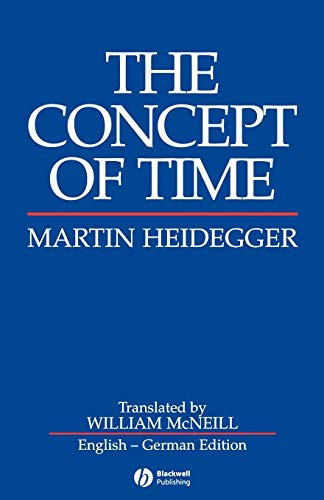
Ebook Info
- Published: 1992
- Number of pages: 80 pages
- Format: PDF
- File Size: 3.54 MB
- Authors: Martin Heidegger
Description
The Concept of Time presents the reconstructed text of a lecture delivered by Martin Heidegger to the Marburg Theological Society in 1924. It offers a fascinating insight into the developmental years leading up to the publication, in 1927, of his magnum opus Being and Time, itself one of the most influential philosophical works this century. In The Concept of Time Heidegger introduces many of the central themes of his analyses of human existence which were subsequently incorporated into Being and Time , themes such as Dasein, Being-in-the-world, everydayness, disposition, care, authenticity, death, uncanniness, temporality and historicity. Starting out by asking: What is time?, Heidegger proceeds to radicalise the concept of time and our relation to it, ending with the question: Are we ourselves time? Am I time?
User’s Reviews
Editorial Reviews: Review “A valuable addition to our growing knowledge about Heidegger’s path to Being and Time.” Tijdschrift voor Filosofie From the Inside Flap The Concept of Time presents the reconstructed text of a lecture delivered by Martin Heidegger to the Marburg Theological Society in 1924. It offers a fascinating insight into the developmental years leading up to the publication, in 1927, of his magnum opus Being and Time, itself one of the most influential philosophical works this century. In The Concept of Time Heidegger introduces many of the central themes of his analyses of human existence which were subsequently incorporated into Being and Time, themes such as Dasein, Being-in-the-world, everydayness, disposition, care, authenticity, death, uncanniness, temporality and historicity. Starting out by asking: What is time?, Heidegger proceeds to radicalise the concept of time and our relation to it, ending with the question: Are we ourselves time? Am I time?William NcNeill is currently British Academy Postdoctoral Research Fellow at the University of Warwick England. He has published several articles on Heidegger and is at present co-translating Heidegger’s 1929/30 course The Fundamental Concepts of Metaphysics: World – Finitude – Solitude. From the Back Cover The Concept of Time presents the reconstructed text of a lecture delivered by Martin Heidegger to the Marburg Theological Society in 1924. It offers a fascinating insight into the developmental years leading up to the publication, in 1927, of his magnum opus Being and Time, itself one of the most influential philosophical works this century. In The Concept of Time Heidegger introduces many of the central themes of his analyses of human existence which were subsequently incorporated into Being and Time, themes such as Dasein, Being-in-the-world, everydayness, disposition, care, authenticity, death, uncanniness, temporality and historicity. Starting out by asking: What is time?, Heidegger proceeds to radicalise the concept of time and our relation to it, ending with the question: Are we ourselves time? Am I time?William NcNeill is currently British Academy Postdoctoral Research Fellow at the University of Warwick England. He has published several articles on Heidegger and is at present co-translating Heidegger’s 1929/30 course The Fundamental Concepts of Metaphysics: World – Finitude – Solitude. About the Author Martin Heidegger – 1889-1976 – is a 20th century German philosopher in the European tradition. His work contributed to such areas as phenomenology and existentialism. Heidegger’s politics were controversial since he was a member of the Nazi party. Two of his influential philosophical works are The Concept of Time and Being and Time. Read more
Reviews from Amazon users which were colected at the time this book was published on the website:
⭐Martin Heidegger (1889-1976) was an influential and controversial German philosopher, primarily concerned with Being, and phenomenology—who was widely (perhaps incorrectly) also perceived as an Existentialist. His relationship with the Nazi party in Germany has been the subject of widespread controversy and debate [e.g.,
⭐,
⭐,
⭐,
⭐, etc.] He wrote many other books, such as
⭐,
⭐,
⭐,
⭐,
⭐,
⭐, etc.The Translator’s Preface notes, “’The Concept of Time’ is a translation of … a lecture which Heidegger delivered to the Marburg Theological Society in July 1924… The lecture presents in a concise yet developed form many of the analyses which were subsequently expanded into Heidegger’s major work ‘Being and Time’ (1927). On account of its concise form (the analyses being presented, as Heidegger says, ‘in the form of theses’ rather than that of detailed explication), the lecture can only be adequately understood and assessed in the light of that later work.”Heidegger states, “If time finds its meaning in eternity, then it must be understood starting from eternity. The point of departure and path of this inquiry are thereby indicated in advance: from eternity to time… If our access to God is faith and if involving oneself with eternity is nothing other than this faith, then philosophy will never have eternity… Philosophy can never be relieved of this perplexity. The theologian, then, is the legitimate expert on time.” (Pg. 1)He states, “Time is that within which events take place. This is what Aristotle has already seen, in the context of the fundamental kind of Being pertaining to natural being: change, change of place, locomotion… Since time itself is not movement, it must somehow have to do with movement. Time is initially encountered in those entities which are changeable; change is in time.” (Pg. 3-4)He explains, “Dasein is that entity which is characterized as being-in-the-world. Human life is not some subject that has to perform some trick in order to enter the world. Dasein as being-in-the-world means: being-in-the-world in such a way that this Being means: dealing with the world; tarrying alongside it in the manner of performing, effecting and completing, but also contemplating, interrogating, and determining by way of contemplation and comparison. Being-in-the-world is characterized as CONCERN.” (Pg. 7)He asserts, “The authenticity of Dasein is what constitutes its most extreme possibility of Being… Authenticity as the most extreme possibility of Dasein’s Being is that ontological determination in which all the aforementioned characters are what they are. The perplexity concerning our grasp of Dasein is grounded not in the limitation, uncertainty or incompleteness of our cognitive faculty, but in the very entity to be apprehended: it is grounded in a fundamental possibility of its Being.” (Pg. 10)He continues, “Dasein is authentically alongside itself, it is truly existent, whenever it maintains itself in this running ahead. This running ahead is nothing other than the authentic and singular future of one’s own Dasein. In running ahead Dasein IS its future, in such a way that in this being futural it comes back to its past and present. Dasein, conceived in its most extreme possibility of Being, is TIME ITSELF, not IN time.” (Pg. 13-14)He observes, “What Dasein says about time it speaks out of everydayness. Dasein as clinging to its present says: the past is what is past, it is irretrievable. This is the past of the everyday present which resides in the present of its busyness. This is why Dasein, thus determined as present, fails to see what is past. That way of viewing history arising in the present merely sees in history an irretrievable busyness: what was going on. The contemplation of what was going on is inexhaustible. It loses itself in its material.” (Pg. 19)He concludes, “Philosophy will never get to the root of what history is so long as it analyses history as an object of contemplation for method. The enigma of history lies in what it means to be historical.” (Pg. 20) He continues, “Let us… repeat the question… It has transformed itself. ‘What is time?’ became the question: ‘Who is time?’ More closely: are we ourselves time? Or closer still: am I my time? In this way I come closest to it, and if I understand the question correctly, it is then taken completely seriously. Such questioning is this the most appropriate manner of access to and of dealing with time as in each case mine. Then Dasein would be: being questionable.” (Pg. 22)This very short book will be of keen interest to anyone studying the development of Heidegger’s thought, or of ‘Being and Time’ in particular.
⭐Martin Heidegger (1889-1976) was an influential and controversial German philosopher, primarily concerned with Being, and phenomenology—who was widely (perhaps incorrectly) also perceived as an Existentialist. His relationship with the Nazi party in Germany has been the subject of widespread controversy and debate [e.g.,
⭐,
⭐,
⭐,
⭐, etc.] He wrote many other books, such as
⭐,
⭐,
⭐,
⭐,
⭐,
⭐, etc.The Translator’s Preface notes, “’The Concept of Time’ is a translation of … a lecture which Heidegger delivered to the Marburg Theological Society in July 1924… The lecture presents in a concise yet developed form many of the analyses which were subsequently expanded into Heidegger’s major work ‘Being and Time’ (1927). On account of its concise form (the analyses being presented, as Heidegger says, ‘in the form of theses’ rather than that of detailed explication), the lecture can only be adequately understood and assessed in the light of that later work.”Heidegger states, “If time finds its meaning in eternity, then it must be understood starting from eternity. The point of departure and path of this inquiry are thereby indicated in advance: from eternity to time… If our access to God is faith and if involving oneself with eternity is nothing other than this faith, then philosophy will never have eternity… Philosophy can never be relieved of this perplexity. The theologian, then, is the legitimate expert on time.” (Pg. 1)He states, “Time is that within which events take place. This is what Aristotle has already seen, in the context of the fundamental kind of Being pertaining to natural being: change, change of place, locomotion… Since time itself is not movement, it must somehow have to do with movement. Time is initially encountered in those entities which are changeable; change is in time.” (Pg. 3-4)He explains, “Dasein is that entity which is characterized as being-in-the-world. Human life is not some subject that has to perform some trick in order to enter the world. Dasein as being-in-the-world means: being-in-the-world in such a way that this Being means: dealing with the world; tarrying alongside it in the manner of performing, effecting and completing, but also contemplating, interrogating, and determining by way of contemplation and comparison. Being-in-the-world is characterized as CONCERN.” (Pg. 7)He asserts, “The authenticity of Dasein is what constitutes its most extreme possibility of Being… Authenticity as the most extreme possibility of Dasein’s Being is that ontological determination in which all the aforementioned characters are what they are. The perplexity concerning our grasp of Dasein is grounded not in the limitation, uncertainty or incompleteness of our cognitive faculty, but in the very entity to be apprehended: it is grounded in a fundamental possibility of its Being.” (Pg. 10)He continues, “Dasein is authentically alongside itself, it is truly existent, whenever it maintains itself in this running ahead. This running ahead is nothing other than the authentic and singular future of one’s own Dasein. In running ahead Dasein IS its future, in such a way that in this being futural it comes back to its past and present. Dasein, conceived in its most extreme possibility of Being, is TIME ITSELF, not IN time.” (Pg. 13-14)He observes, “What Dasein says about time it speaks out of everydayness. Dasein as clinging to its present says: the past is what is past, it is irretrievable. This is the past of the everyday present which resides in the present of its busyness. This is why Dasein, thus determined as present, fails to see what is past. That way of viewing history arising in the present merely sees in history an irretrievable busyness: what was going on. The contemplation of what was going on is inexhaustible. It loses itself in its material.” (Pg. 19)He concludes, “Philosophy will never get to the root of what history is so long as it analyses history as an object of contemplation for method. The enigma of history lies in what it means to be historical.” (Pg. 20) He continues, “Let us… repeat the question… It has transformed itself. ‘What is time?’ became the question: ‘Who is time?’ More closely: are we ourselves time? Or closer still: am I my time? In this way I come closest to it, and if I understand the question correctly, it is then taken completely seriously. Such questioning is this the most appropriate manner of access to and of dealing with time as in each case mine. Then Dasein would be: being questionable.” (Pg. 22)This very short book will be of keen interest to anyone studying the development of Heidegger’s thought, or of ‘Being and Time’ in particular.
⭐A valuable read for those interested in Heidegger, and I think, because of the different approach to the topic of time, this might be a better place to start for those planning on jumping into “Being and Time.” In fact, the title is a bit misleading, as many of Heidegger’s titles are, as it is more of an introduction to his conception of time. Moreover, it is sort of the groundwork for what one encounters in “Being and Time.” That’s not to say that this little book won’t be valuable to someone who has already read his magnum opus. There were numerous items that Heidegger pointed to, regarding time, that I don’t recall coming up in “Being and Time,” or that I found better (more clearly) explicated what was meant in “Being and Time.”Overall, this is a fascinating book that is so short I think it’s a must-read: the payoff far exceeds the time and effort required, even if only mildly interested in the text.
⭐I wish I had read this before Being and Time. It feels like you’re sitting in a lecture room with Heidegger and he is describing to you his ideas for a new book, hint hint–Being and Time.
Keywords
Free Download The Concept of Time 1st Edition in PDF format
The Concept of Time 1st Edition PDF Free Download
Download The Concept of Time 1st Edition 1992 PDF Free
The Concept of Time 1st Edition 1992 PDF Free Download
Download The Concept of Time 1st Edition PDF
Free Download Ebook The Concept of Time 1st Edition