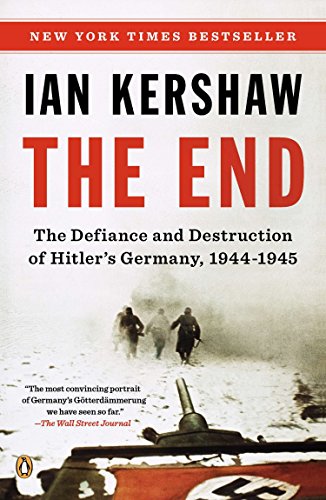
Ebook Info
- Published: 2012
- Number of pages: 608 pages
- Format: PDF
- File Size: 5.79 MB
- Authors: Ian Kershaw
Description
From the author of To Hell and Back, a fascinating and original exploration of how the Third Reich was willing and able to fight to the bitter end of World War IICountless books have been written about why Nazi Germany lost the Second World War, yet remarkably little attention has been paid to the equally vital questions of how and why the Third Reich did not surrender until Germany had been left in ruins and almost completely occupied. Drawing on prodigious new research, Ian Kershaw, an award-winning historian and the author of Fateful Choices, explores these fascinating questions in a gripping and focused narrative that begins with the failed bomb plot in July 1944 and ends with the death of Adolf Hitler and the German capitulation in 1945. The End paints a harrowing yet enthralling portrait of the Third Reich in its last desperate gasps.
User’s Reviews
Editorial Reviews: Review “Kershaw’s comprehensive research, measured prose, and commonsense insight combine in a mesmerizing explanation of how and why Nazi Germany chose self-annihilation.” — Publishers Weekly (starred review)”[A]superb examination of the final defeat of Hitler’s tyranny…an excellent portrait of the regime’s death throes.” — Booklist (starred review)”This is an astonishing story well told by the reigning English-speaking master of Third Reich history…A carefully considered and powerfully told saga.” — Kirkus (starred review) About the Author Ian Kershaw, author of To Hell and Back, The End, Fateful Choices, and Making Friends with Hitler, is a British historian of twentieth-century Germany noted for his monumental biographies of Adolf Hitler. In 2002, he received his knighthood for services to history. He is a fellow of the British Academy, the Royal Historical Society, the Wissenschaftskolleg zu Berlin, and the Alexander von Humboldt-Stiftung in Bonn, Germany. His newest book, Personality and Power, will be published in November, 2022.
Reviews from Amazon users which were colected at the time this book was published on the website:
⭐The German High Command in 1918 knew the war was lost, even though Allied armies had not penetrated German soil, and essentially defaulted peace-making to the Social Democrats (who suffered the anger of German nationalists in subsequent years). WW II was a far different story. The Third Reich under Hitler fought on, fanatically in many areas, to a catastrophic end and to the utter destruction of the nation. I can’t recall any examples from history where a nation, confronted by massive armies from numerous sides whose manpower and weaponry exceeded Nazi Germany’s by 5 and 10 times, respectively, and virtually defenceless from repeated air raids which hollowed out its cities, refused to surrender. Near the end the country was completely overrun by Allied and Soviet armies that linked up in many sectors, and yet Hitler remained in his bunker directing his dutiful Wehrmacht and deploying imaginary armies. There was no internal coup (like against Mussolini in 1943), no mass protests or strikes like in 1918, and no mutiny from the armed forces. It just may have been a unique event in world history.Ian Kershaw, in this very well-written and well-balanced history, addresses the internal dynamics of Nazi Germany from the July 1944 attempted officers’ coup to the calamitous end, for the German people, in May of 1945, and tries to answer the question of why the Germans fought on to utter ruination. He discusses the Allied “unconditional surrender” requirement, which supposedly hindered the German resistance, but whose effect Kershaw deems marginal. He discusses the honor and duty of the officer corps and the discipline of the troops as contributing factors. Of more importance, from my reading, were: (1) the intensified repression of the regime orchestrated by the SS and Gestapo after the bomb plot, e.g., the public hanging of “shirkers” and “defeatists,” (2) Nazi Party fanaticism, (3) the terrible fear of the Soviet armies based on Soviet atrocities and on acknowledgement of terrible Nazi depredations in the Soviet Union, and (4) the continued charismatic hold on power of Hitler up until his suicide in the bunker. Generals who saw the situation as hopeless would emerge from a conference with Hitler in the bunker with renewed fighting zeal. I find it amazing that after Hitler’s nervous “breakdown” on April 22nd, perceived by top Nazis Goering and Himmler as a seeming abdication, he could still order their arrests and expulsion from the Party only days before the end.With no possible “victory” in sight, not even a negotiated surrender, a capitulation was completely unacceptable. Goebbels saw the complete devastation and destruction at the end as almost heroic, and thought the German people in a hundred years would remember the Nazis as courageous martyrs. Hitler on the other hand, had lost his faith in the German people. When Hitler issued his infamous “Nero Decree” in March 1945 eliminating almost all means for the people’s subsistence, his Minister Speer tried to dissuade him from such pointless destruction, to which Hitler replied: “It is not necessary to worry about what the German people will need for elemental survival. On the contrary, it is best for us to destroy even these things. For the nation has proved to be the weaker, and the future belongs to the stronger eastern nation [Soviet Union]. In any case, only the those who are inferior will remain…..for the good have already been killed.” Such a heartless example of Hitler’s Social Darwinism, and yet many Germans were saying “Heil Hitler” to the end!
⭐Good read and Interesting but a little difficult to stay into.
⭐Ian Kershaw’s book “The End” is the expected product of the same careful research and writing which characterizes his work in general. What he does in it is to take the very complex story of the end of the Second World War and ties together memoirist and diary accounts of the horrendous events of the period roughly from the attempted assassination of Hitler in July 1944 to the end of the war including the curious coda; the dumb show of the “Doenitz government” in Flensburg. In doing this, Kershaw does a masterful job of story telling; making sense of all this complexity.The book could leave the reader somewhat disappointed. Like his fine work “Fateful Choices”, it is done in a style which, while never purple is at times light indigo in prose style. This makes it quite readable. You are left, however in no doubt that this will not surprise you or offer up a major change of opinion about much of anything and certainly not the deep moral issues. Has he really covered the subject in a way that weighs up the evidence? Most of his cited evidence comes from German sources as, of course, it would have to Many of his Nazis (in fact I should say “most”)still resonate as being of the Hollywood sort. At this point I will have to say, in order to drive you away, that from my earliest exposure (I’m 78) to the facts of the Second World War in the air I concluded that Vice Air Marshall Harris should have gone to the gallows at Nuremberg in the place of the suicide,Goering. Goering, who kept the allies from too much self righteous exultation by unmasking the hypocrisy of the prosecution. One of the stories Kershaw might have told was the rise and fall and then the final rise of Goering in German public opinion,,,,from “in der Luft da ist er Meister”…to “Schultz”, to unmasker of hypocrisy) Even Chester Nimitz had to admit that there was nothing that Doenitz had done to put him in the dock that Admiral Nimitz had not done himself.As far as I have been able to judge, bloody-mindedness by leaders knows no national or ethnic bounds. Even our esteemed President who shed an occasional tear in national mourning over the horrors of Newtown, is the same person who calls in cowardly drone strikes and scoffs at the “collateral damage” No one can explain how a Nazi perpetrator is qualitatively different from any leader who is willing and able to create hekatombs of victims; and goes on to do so…..This may seem a hard judgement but the only one which holds out any hope for a future for the human race. You can put them all together the Cordell Hulls with the Ribbentrops (Ribbentropp looked better in Tuxedo and could dance the pants off Cordell Hull)From Kershaw, you will get no hint of the balance of terror which characterized the entire horror story from 1914 to 1945. For example, in describing the plight of the eastern refugees he doesn’t even mention the horrible and massive reprisals taken by eastern Europeans who took the opportunity of 1944-45 to roll back the German horror of Lebensraum. An eye for an eye it’s always worked for us. Nor does the sinking of the Wilhelm Gustloff in the Baltic carrying refugees, with a loss of life three to four time greater than the Titanic qualify for more than honorable mention. One of the sources cited often by Kershaw is Klemperer, a Jewish philologist who lost his job at the University with the Machtuebernahme in Dresden. After the pogroms and the allied Terror-bombing and fire storm he writes in his diary the day after the Fire Bombing (who’s victims, in the interest of our self esteem, we have negotiated down to a mere 40,000) “Thank God for the NSV” ( The Nazi welfare organization), “without which we would have perished”!It’s time that someone wrote the real history of World War Two in which only some Nazis were sent over by central casting. Nietzsche was so right….There’s nothing quite as disgusting as righteousness on parade.
⭐Sir Ian Kershaw notes that continuing to fight on to the bitter end in a war is rare. Casualties spiralled, German military losses in the last 10 months of the war were equal to those in the four years to July 1944. 350,000 German soldiers dying in each month of the final cataclysm. Allied bombing extended ever deeper and more destructively into the Reich. Berliners took refuge from bombing in East Prussia. Faced by the Russian advance, Koch its Gauleiter intervened to prevent evacuation with fateful consequences for those in East Prussia.So why did the Germans fight on?Fear of the Soviets and after the brutal way in which the Germans had fought on the Eastern Front, with ill-use of Soviet prisoners the norm, meant Germans expected similar treatment and fought on.The Party remained in control even as administration and society broke down. This was the final step in a process of increasing Nazi Party intervention with unrestrained violence exercised by hanging and kangaroo courts judging anyone inclined to give up the fight, or suspected of doing so. The regime ,which fought on, became ever more dangerous for its own citizens.Even if belief in Hitler and the Party was weakened the population and army was still concerned for volk, country and homeland and fought on.In 1943 Himmler explained extermination of the Jews to the Party Gauleiters making sure they shared the knowledge of, and responsibility for it, so would fight on. Hitler didn’t want prisoners from the camps to be liberated by the allies, initiating the terrible death marches. Wandering under guard control across the Reich, they ensured the German people too shared knowledge of the treatment of its internal enemies including the Jews. When prisoners escaped from the forced marshes, members of the police, Wehrmacht, Hitler Youth and ordinary citizens participated in hunting them down.The ethos of the Officer Corps meant it fought on, unwilling to disobey orders not to retreat, even when such orders were self-destructive. Hitler purged the German generals leaving only Nazi believers in place, so after the July attempt on Hitler’s life, there was no possibility of an internal revolt.Nazi Germany was a plutocracy, rule of many, In the last months it was dominated by a quadrumvirate of Nazi grandees, Himmler, who controlled the SS and camps and Bormann who controlled the Party and used his proximity to Hitler to reinvigorate it, Goebbels, the propagandist Minister of Information, who both believed and created the Hitler Myth, and Speer, Armaments Minister, whose efforts, including the use of slave labour, meant German armaments’ manufacture did not peak until the last year of the war. Rivalry within this group was typical of the Byzantine nature of the Nazi state in which there was continuous jockeying for position.However Germany was also a monocracy, rule of one, that of the charismatic little seen Führer. “Working towards the Führer” resulted in an inevitable radicalization of the state, which continued right to the End. Hitler wouldn’t consider peace-making. To do so would have been to repeat the betrayal of the 1918 German Armistice against which he had railed. The dominant elite, divided as they were and mired in its crimes, possessed neither the will nor means to prevent Hitler taking Germany to total destruction. Hitler’s suicide on 30 April 1945 with the Russians breaking into Berlin was followed on 9 May by capitulation by the regime led by the Nazi, High Admiral Dŏnitz, Hitler’s nominee as his successor.Kershaw’s view is that personal dictatorship by the Führer, was the final reason Germany fought on to its End. Once, he was no longer there, the regime failed the End reached. Chilling, and thought provoking,
⭐This book should be read by the whole of Great Britain. I do sincerely hope that it gets translated into German, where every German man women and child should read it. It should be made available to all schools in Germany.When I see or hear where the blame lies for all the most horrendous treatment of people what ever their nationality during the war years, I find it very hard to apportion blame, as the press and media do, to the Nazis alone, this is the trend, just as if the rest of the German nation were innocent of any part of this. When one looks at old news reels, the German people are there participating in the rallies in their thousands and thousands with their right arm raised in salute. They were there with Hitler their Fuhrer, rejoicing at his success’s, destroying beautiful countries, and murdering thousands and thousand of innocent people, simply because they were not part of the .Ayran race. all that did not fit in were liquidated in their millions. The forced marches, 1944/45 is quite unimaginable, the brutality during these time by the German guards. The Nazis are German people, lets not forget that, and the German nation were in the whole barbaric mess up to their necks. they knew what was going on. Twice now the Germans have destroyed nations and people in an totally indescribable, unimaginable way. Hard to understand that they are in the EU?Thank goodness for the Russian, who paid the highest price of all the armies fighting Germany.Read Ian Kershaw’s book Germany.
⭐The coincidences are that Professor Sir Ian Kershaw and the writer were born on the same day, 29 April and as it turns out, both read history at university. In this writer’s case, medieval to modern. However, the professorship and knighthood have yet to materialise, so in the meantime some thoughts on Sir Ian’s book entitled ‘The End: Germany 1944-45′. Firstly, any undergraduate reading history related to the Nazi era or for that matter anyone who has a serious interest in this subject should read this book, since it approaches the subject in a different way. It is unbiased and well researched as you would expect and is easily understood. The second factor is the actual approach to the question – why did Nazi Germany continue fighting when it clearly could not sustain and win the war against the allies? In some respects Sir Ian is assessing the psychological aspects, what in today’s jargon are called drivers, for example, some historians’ have previously argued that General Dwight Eisenhower’s demand for complete surrender of the Wehrmacht in the East as well as the West as opposed to some alternative surrender arrangement was the reason Germany continued fighting, an argument which Churchill brushed aside as untrue but may still have had some impact . Various other strong arguments are put forward in the book, including a significant and undoubtedly real fear of what the Soviet Russian army would do once they overran the German army and SS. Retribution would know no bounds, so German’s, both military and civilians alike had every reason to expect no quarter and they didn’t get it. If there is one major reason why Germany continued to fight, then it may well be innate fear of the Nazi regime itself. Equally, Germany did not have a democratic history, even during the Weimar Republic between 1918 and 1933, it still remained underneath the smoke and mirrors the Deutsches Reich. Then there is the question of post-war open discussion, or lack of it. Attempting to understand the question ‘why’ Germany continued to fight only started to be more openly discussed by German’s themselves, particularly academics and intellectuals, from the 1960s onwards, which has made this whole subject both complicated and part of the continuing collective memory. Do read Sir Ian’s ‘The End: Germany 1944-45′ it is thought provoking and highly recommended secondary source reading related to the Nazi era.
⭐The End is a good example of much that is wrong with so much modern history written about this period. It tells the dramatic story of how Germany collapsed in on itself between 1944 and 1945, often in harrowing detail. 75 years on, it is hard to imagine the horrors that people lived through, and the sense of destruction that swept all parts of the country. But, this could have been done so much more effectively in a shorter book that offered more analysis. Kershaw crams in the examples, and as other Amazon reviewers have noted, much of the content is repetitive and in places badly written. The last couple of chapters in particular feel like they have been rushed, and the reader almost becomes desensitised to the horrors being described. The challenge here is for more historians to offer leaner, more insightful books. AJP Taylor and Norman Stone are two examples of how this can be done. Both have their faults as historians as well, but they knew the power and value of writing succinctly. Kershaw is a world expert on this period of history, but The End simply rambles on way too long.
⭐For the first quarter of the book I thought Kershaw was going to come to the same continuous conclusion that the failure of the Stauffenberg plot and the Allies’ decision to implement ‘Unconditional Surrender’ was the reason why the regime became so ultra radical for the final year of the war, but by the ‘guts’ of the book I realised that Kershaw was delving into far more greater depth than I first thought as the analysis flowed with the narrative. Indeed, the sheer size and reach of the regime, through German society and its Armed forces was quite amazing, but the way senior and more worryingly low level people reacted in the last year to assert the regime’s dominance (thus protracting the war) is just bewildering and one of the many reasons why this period of History is so facinating.Kershaw is brilliant at relating the keys players of the ‘Quadumvirate’ as he calls it, Speer, Goebbels, Bormann, Himmler to their individual relationship the the Hitler, the state and the continuation of the war. But he also brings so many other key players to the table, whose actions and decisions helped decide the fate of thousands. Donitz, Jodl, Keitel to name but a few Generals and of course the main district (Gauleiter) heads that proved so callous right until the last moments of the war.There are so many stories of decisions that caused suffering when early capitulation must have been a more sensible option, even when facing the Russian army.But as Kershaw says, the a vast majority of the German state knew what wrongs had gone on in the previous years and perhaps had nothing to lose but to fight on. It was really such a complex fusion of historical, cultural and political forces that caused this potent set of circumstances in Europe, arguably stretching back way beyond 1918, that led to so many civilian deaths and countless accounts of misery.The narrative really helps with the sheer desperation of the last months of the regime and its total inability to face the facts that were approaching them. The trouble for the beaten people of Germany was that they had backed a regime in the ‘good’ times, the revival of Germany from 1933 and for three successful years of warefare, it was too late to find an alternative as the system was geared around the success being down to one man. They ultimately went down with him, and this books shows just how that happened.Overall this book was thoroughly enjoyable, shocking, full of insight and packed with detail. It also left me wondering how so many of the high level names mentioned were able to live long lives after the war. Hitler was surrounded by ‘yes men’, some with distinguished careers before their involement in the regime, which makes their involement far worse for me. They were duped alright, but carried out harsh measures on their own people as well as their enemies that should have been punished as soon as the war was over. I had better start reading about the Nuremberg trials asap…
Keywords
Free Download The End: The Defiance and Destruction of Hitler’s Germany, 1944-1945 in PDF format
The End: The Defiance and Destruction of Hitler’s Germany, 1944-1945 PDF Free Download
Download The End: The Defiance and Destruction of Hitler’s Germany, 1944-1945 2012 PDF Free
The End: The Defiance and Destruction of Hitler’s Germany, 1944-1945 2012 PDF Free Download
Download The End: The Defiance and Destruction of Hitler’s Germany, 1944-1945 PDF
Free Download Ebook The End: The Defiance and Destruction of Hitler’s Germany, 1944-1945